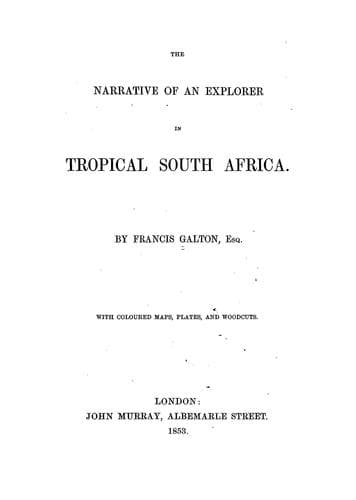
The narrative of an explorer in tropical South AfricaGalton, Francis
History
The narrative of an explorer in tropical South Africa
Galton, Francis
South Africa -- Description and travel
I do not think that a perfect head-dress has yet been invented by
man. A light hunting-cap is very convenient among thick trees, but it
cannot be used as a nightcap in the bivouac. As regards colours of the
dress, infinite misunderstanding generally prevails, as may at once be
perceived by the colour of the uniform in which our rifle corps are
clothed. People have an idea that because shadows are dark, and because
people who crouch in ambuscade are generally in shadows, that therefore
their clothes should be dark also. They forget that the same shade which
deepens the tint of the trees gives at the same time an extra depth to
the colour of the man’s clothes. As a first approximation to obtaining
the best-coloured dress for the purposes of concealment, one would
say, let it be of the prevailing hue of the country it is to be used
in; so that, if the clothes were dropped on the ground, they would be
positively undistinguishable from it at a short distance, whatever blaze
of light or depth of shadow fell on it. I am acquainted with no country
in the world in which “rifle-green” would answer this requirement. But,
going a step further, we find that in no case hardly is the colour of
the land one uniform hue, but that a cloth of any one colour, even
though it be of the prevailing tint, catches the eye from its mass.
It is therefore better that the colour of the dress should not be the
same throughout, but irregularly broken, and that too in a manner which
does not contrast too strongly with the disposition of the scenery,
as for instance, the stripes on a tiger’s hide being vertical are far
less conspicuous among the upright stems and reeds than if nature had
disposed them horizontally. A little experimentalizing will show another
curious and very unexpected result, namely, that if the very brightest
colours are used in spots or stripes, or in any other design, but in
such proportion that their actual mixture would have produced the sober
tint required, then, at rifle distances, unless the pattern be too large,
all individuality of the colours will be found to have disappeared, and
they will have merged into exactly the same tint that would have been
produced had the same colours been mixed together in the same proportion
on the pallet. It will also be found that a very large pattern may be
used if the margins of the various bands or spots of colour be a little
shaded off. In this way we can in a great degree account for the gaudy
liveries with which the most skulking of animals are usually dressed. The
cat tribe is almost universally decked out with spots or bars. Snakes
and lizards are the most brilliant of animals; but all these, if viewed
at a distance, or with an eye whose focus is adjusted, not exactly at
the animal itself, but to an object more or less distant than it, become
apparently of one hue, and lose all their gaudiness. No more conspicuous
animal can well be conceived, according to common idea, than a zebra;
Public-domain text, read in full here on John Shaqi.
Reviews
Reviews
No reviews yet
Be the first to share your thoughts on this work.
Elsewhere in the archive
Join the Discussion
Join the discussion
Sign in to leave a comment or review.
Sign InorCreate an account