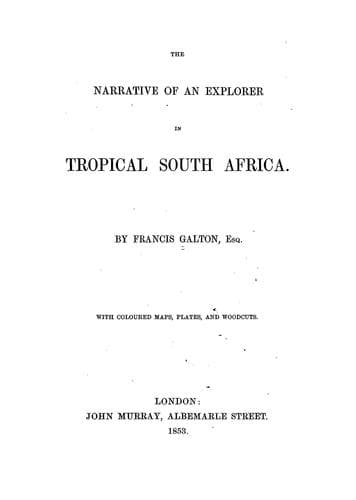
The narrative of an explorer in tropical South AfricaGalton, Francis
History
The narrative of an explorer in tropical South Africa
Galton, Francis
South Africa -- Description and travel
but on a bright star-light night the breathing of one may be heard close
by you, and yet you will be positively unable to see the animal. If the
black stripes were more numerous he would be seen as a black mass; if
the white, as a white one; but their proportion is such as exactly to
match the pale tint which arid ground possesses when seen by moonlight.
I therefore protest against the usual notion that people have, as
exemplified in the choice of a rifleman’s dress. It is infinitely too
dark; and this, in addition to the squareness of the hat, makes an
object of him that is particularly calculated to attract attention. It
would be, I am sure, hopeless to stalk wary animals in such a costume,
unless the character of the country gave most peculiar facilities for
doing so. A man who wishes to dress for stalking may indulge his smart
fancies to a great extent, but should test every pattern that he selects
by viewing its effect at a slight distance, say twenty yards, the main
point of all being, that the depth of tint (leaving every consideration
of colour aside) should be neither too light nor too dark. I have
frequently amused myself by cutting out in paper figures of men, all of
the same size and shape, and painting one a rifle-green, and the others
bright blue, yellow, and red, in spots or patterns. I have then stuck up
these figures against the face of a landscape painting, and retreating
ten or twelve yards, the dark-green form of the rifleman, place it where
I would, remained a prominent unmistakable mass, while the others faded
as it were into the foliage, and could not be distinguished from it.
It requires a few trials to hit off the proportions of the different
colours used to produce a perfect result. I may add, in case the reader
might wish to experimentalise, that it saves much running backwards and
forwards in doing it to place a looking-glass some distance in front,
and, as the painting goes on, to hold the sketch up from time to time and
observe the effect in the distant reflection.
To return from this long digression to my narrative.
On the 1st of November, the eighth day after leaving Elephant Fountain,
we heard a report about Hans, which, though untrue, alarmed me
exceedingly; it was to the effect that he had shot himself, and that the
waggons lay on this side of Eikhams. I was so anxious, that I pushed the
oxen through the night, and with but little intermission we were again on
the road in the morning; we there found Damaras, who, to my great relief,
assured me that he was alive and well, and I therefore left the waggon
oxen with the men, to have drink and food, and started on first, and
walked till I had the pleasure of seeing Hans again, who, after all, had
had no accident whatever; he had every thing in perfect order, and, as
usual, had to show me some result of careful thrift and hard work.
Public-domain text, read in full here on John Shaqi.
Reviews
Reviews
No reviews yet
Be the first to share your thoughts on this work.
Elsewhere in the archive
Join the Discussion
Join the discussion
Sign in to leave a comment or review.
Sign InorCreate an account