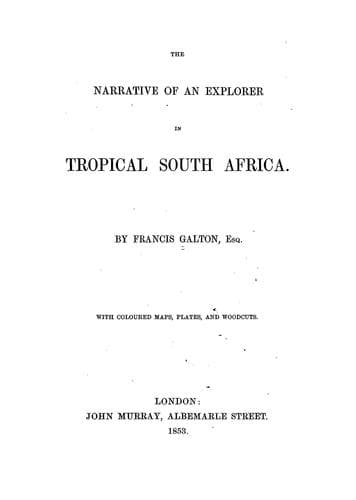
The narrative of an explorer in tropical South AfricaGalton, Francis
History
The narrative of an explorer in tropical South Africa
Galton, Francis
South Africa -- Description and travel
the Damara chiefs, breaking in the oxen and hoping for the rains. It is a
charming place, and almost a sufficiency of game was killed to feed us.
CHAPTER V.
Personnel.—Commissariat.—Daily Allowances.—Start on the
Expedition.—Damara Obtuseness.—Inability to count.—Information
withheld.—Kahikenè sends to us.—Arrive on the high
Tableland.—Superstitions on Food.—Meet Kahikenè.—His
Difficulties.—Gives me Advice.—Information about the
Road.—Four Oxen stolen.—The Culprits are punished.—Recognising
lost Oxen.—Hear of another Road.—Reach Omatako.—African
Puma.—Eshuameno.—Chipping the front Teeth.—View from the
Hill.—Ja Kabaca.—Climb Omuvereoom.—A Snake.—Seriously
obstructed by the Thorns.—Reach Otjironjuba.—How to make
Soap.—We catch some Bushmen.—Learn a little and travel
on.—Doubts about our route.—Arrive at a Werft.—Are guided
onwards.—Omanbondè.—Hippopotami.
The morning of March the 3rd found us packed up, and starting for our
exploring journey. We tugged along the heavy Swakop sand, and outspanned
after three hours at a fountain, passing at length into a country which,
I believe, no European eye had ever before witnessed.
I may now review our caravan: it consisted of two waggons, both filled
with things; the large one had a solid deck over all, and was curtained
into two compartments; Andersson slept in the front one and I in the
back if the ground was wet. Spare guns were lashed inside this waggon,
and canvass bags for books and for other etceteras, but we could never
make the waggon a place to read in with any comfort, for it was far
too full of articles of exchange. The small waggon was the receptacle
for the men’s sleeping clothes, besides its regular freight. Nobody
slept in it except during heavy rains. John St. Helena drove the large
waggon and led the way; Phlebus the small one. John Williams, Onesimus,
and John Allen were all engaged as leaders, but in practice Onesimus
always led the large waggon and any odd Damara led the other. Hans, John
Morta and Timboo were the remaining servants. My natives were constantly
changing. I am quite unable to give the names of the Ghou Damups, for two
reasons: the first, perhaps a sufficient one, is that they are totally
unpronounceable to any European mouth, and altogether beyond the powers
of our alphabet to represent;—the second, that they were invariably
christened afresh by my men as soon as they entered my service. The sort
of names these negroes answered to will perhaps convey a better notion of
their character and style than a longer description—there was a “Grub,”
a “Scrub,” a “Nicodemus,” a “Moonshine,” and a “Toby.” The Damaras
generally retained their own names; they were much the more stylish of
the two. My Damara party at starting was something as follows:—
Public-domain text, read in full here on John Shaqi.
Reviews
Reviews
No reviews yet
Be the first to share your thoughts on this work.
Elsewhere in the archive
Join the Discussion
Join the discussion
Sign in to leave a comment or review.
Sign InorCreate an account