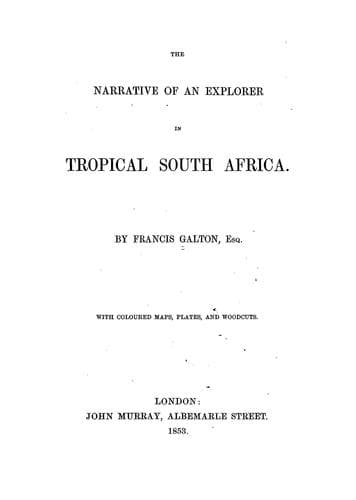
The narrative of an explorer in tropical South AfricaGalton, Francis
History
The narrative of an explorer in tropical South Africa
Galton, Francis
South Africa -- Description and travel
1 Springbok, or roebuck equal to 1 sheep.
1 Hartebeest ” 2 ”
1 Zebra, or gnu, or gemsbok ” 4 ”
1 Giraffe ” 2 oxen.
1 Black or Keitloa rhinoceros ” 3 ”
1 White ” 4 ”
I possessed seventy-five oxen and one calf; of these fifty-seven had
been inspanned, including the ride and pack-oxen. My ride-oxen were
Frieschland, Ceylon, Timmerman, Buchau and Fairland. Andersson had
Spring. All these would also carry packs as a matter of course, but
there were others simply pack-oxen. Hans had three ride-oxen, six cows,
and five calves; John Allen had two ride-oxen. There were also two
heifers that belonged to some of the other men. Gross total of oxen,
and cows and calves, ninety-four; but my own flock of sheep was reduced
to twenty-four. I had therefore (allowing twenty slaughter oxen) full
provisions for two and a half months for all my party, independently of
game. This was not nearly as much as I should have liked, but I trusted
to buy more on my journey, and also to get some shooting.
_March 4th._—This was our most difficult day: the Swakop ran through
a gorge so broken and narrow, as not to admit a waggon, and the only
road we could find out of it lay for some considerable distance along a
narrow ridge of jagged rock with a precipitous fall on our left. Hakis
thorns and ravines made the country quite impenetrable everywhere else;
our road was horrible; the waggon crashed and thundered and thumped, but
somehow or other got safe over. If I had to undergo two or three more
such days of journeyings, the waggons would have to be left behind. The
oxen were dreadfully wild; there was no guiding or restraining them down
hill, but they tossed themselves about and charged like wild buffaloes;
it still took us an hour and a half to inspan the two waggons, and every
man was actively employed. We went only three hours, and slept at the
furthest watering-place that Hans and I had explored. Now we had to trust
to the guides, whose ideas of time and distance were most provokingly
indistinct; besides this, they have no comparative in their language,
so that you cannot say to them, “which is the _longer_ of the two, the
next stage or the last one?” but you must say, “the last stage is little;
the next, is it great?” The reply is not, it is a “little longer,” “much
longer,” or “very much longer;” but simply, “it is so,” or “it is not
so.” They have a very poor notion of time. If you say, “Suppose we start
at sunrise, where will the sun be when we arrive?” they make the wildest
points in the sky, though they are something of astronomers, and give
names to several stars. They have no way of distinguishing days, but
reckon by the rainy season, the dry season, or the pig-nut season. When
inquiries are made about how many days’ journey off a place may be, their
ignorance of all numerical ideas is very annoying. In practice, whatever
Public-domain text, read in full here on John Shaqi.
Reviews
Reviews
No reviews yet
Be the first to share your thoughts on this work.
Elsewhere in the archive
Join the Discussion
Join the discussion
Sign in to leave a comment or review.
Sign InorCreate an account