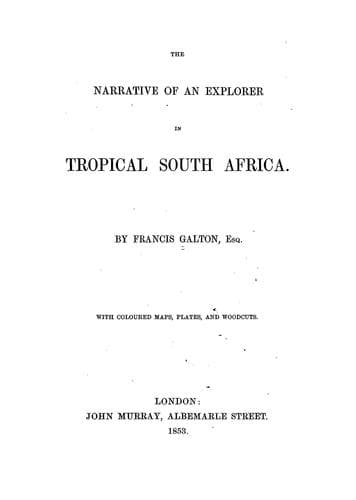
The narrative of an explorer in tropical South AfricaGalton, Francis
History
The narrative of an explorer in tropical South Africa
Galton, Francis
South Africa -- Description and travel
they may possess in their language, they certainly use no numeral
greater than three. When they wish to express four, they take to their
fingers, which are to them as formidable instruments of calculation as
a sliding-rule is to an English school-boy. They puzzle very much after
five, because no spare hand remains to grasp and secure the fingers that
are required for “units.” Yet they seldom lose oxen: the way in which
they discover the loss of one, is not by the number of the herd being
diminished, but by the absence of a face they know. When bartering is
going on, each sheep must be paid for separately. Thus, suppose two
sticks of tobacco to be the rate of exchange for one sheep, it would
sorely puzzle a Damara to take two sheep and give him four sticks. I
have done so, and seen a man first put two of the sticks apart and take
a sight over them at one of the sheep he was about to sell. Having
satisfied himself that that one was honestly paid for, and finding to his
surprise that exactly two sticks remained in hand to settle the account
for the other sheep, he would be afflicted with doubts; the transaction
seemed to come out too “pat” to be correct, and he would refer back to
the first couple of sticks, and then his mind got hazy and confused, and
wandered from one sheep to the other, and he broke off the transaction
until two sticks were put into his hand and one sheep driven away, and
then the other two sticks given him and the second sheep driven away.
When a Damara’s mind is bent upon number, it is too much occupied to
dwell upon quantity; thus a heifer is bought from a man for ten sticks
of tobacco; his large hands being both spread out upon the ground, and
a stick placed on each finger, he gathers up the tobacco; the size of
the mass pleases him, and the bargain is struck. You then want to buy a
second heifer: the same process is gone through, but half sticks instead
of whole ones are put upon his fingers; the man is equally satisfied
at the time, but occasionally finds it out and complains the next day.
Once, while I watched a Damara floundering hopelessly in a calculation
on one side of me, I observed Dinah, my spaniel, equally embarrassed on
the other. She was overlooking half a dozen of her new-born puppies,
which had been removed two or three times from her, and her anxiety was
excessive, as she tried to find out if they were all present, or if any
were still missing. She kept puzzling and running her eyes over them
backwards and forwards, but could not satisfy herself. She evidently had
a vague notion of counting, but the figure was too large for her brain.
Taking the two as they stood, dog and Damara, the comparison reflected no
great honour on the man. Hence, as the Damaras had the vaguest notions
of time and distance, and as their language was a poor vehicle for
expressing what ideas they had, and, lastly, as truth-telling was the
exception and not the rule, I found their information to be of very
little practical use.
Public-domain text, read in full here on John Shaqi.
Reviews
Reviews
No reviews yet
Be the first to share your thoughts on this work.
Elsewhere in the archive
Join the Discussion
Join the discussion
Sign in to leave a comment or review.
Sign InorCreate an account