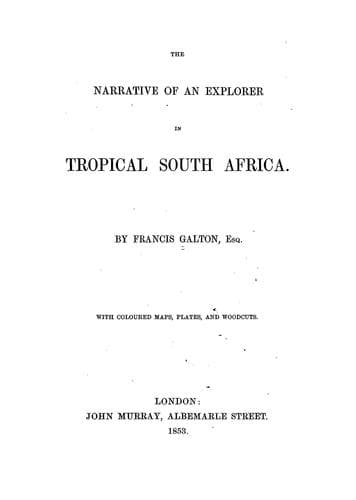
The narrative of an explorer in tropical South AfricaGalton, Francis
History
The narrative of an explorer in tropical South Africa
Galton, Francis
South Africa -- Description and travel
deer; and though a nine-shilling gun will buy five fine oxen, yet that is
no proof of the cheapness of cattle with the Damaras, but rather of the
dearness of guns amongst them. Any man, not himself possessed of cattle,
may be murdered without fear of the consequences, if payment of two oxen
be made to his relations, as that by the custom of the country is amply
sufficient blood-money. Milk, the great article of diet among the richer
Damaras, though used in such profusion, can rarely be bought, for there
are some superstitions about it also. Each Damara, who lives entirely or
chiefly on milk, the rest of his food being pig-nuts, drinks from one to
two gallons daily. Now it is reasonable to suppose that a day’s provision
of meat would be exchangeable for one of milk, especially as meat is
more prized, and the greater dainty of the two; but it is not so, nor
indeed anything like it. If a head of game be shot and bartered with the
natives, it will be found a difficult matter to obtain a single gallon of
milk for a whole gnu or zebra. Sweet milk can hardly be ever obtained,
because Damaras, like all other milk-drinking nations, use it only when
sour, and the cow is milked into the tainted vessels. They firmly believe
that a cow’s milk will fail her if they milk her into anything freshly
washed and clean. The milk of these cows actually does fail them if the
calf be taken away. It is the same with those in parts of South America.
_March 12th._—We had arrived at the place where Kahikenè waited for
us. He and about forty magnificently made and well-armed Damaras were
standing under the trees. As the waggons came near, the men all fell
into a single file, according to their usual custom, which Kahikenè
headed, and they walked up to me. He had quite the manners of a chief,
and received me very well. I gave him some gilt ornaments as presents,
which, although he was in mourning, he put on in compliment to me: the
Damaras strip off their ornaments when in mourning. He had been in great
distresses of late. After Jonker had attacked him, and scattered his
people at Schmelen’s Hope, Omagundè’s son, who was encamped two days in
front of us, followed up the attack, and killed some of his children, and
took others prisoners, leaving only one lad with him. The greater number
of his oxen were also taken, and he was left almost destitute, with but
the remnant of a tribe, and was now about to make a last desperate attack
upon his enemy. A few years ago, Kahikenè was the most powerful chief
in Damara-land, and, like Katjimasha, had once allied himself with, and
afterwards had separated from, Jonker. Subsequent to this separation,
Jonker attacked him, and he made a bold retaliation the next night. Ever
since that he had been a marked man with the Hottentots, and werft after
werft of his had been swept away, until he was reduced to the condition
in which I found him.
Public-domain text, read in full here on John Shaqi.
Reviews
Reviews
No reviews yet
Be the first to share your thoughts on this work.
Elsewhere in the archive
Join the Discussion
Join the discussion
Sign in to leave a comment or review.
Sign InorCreate an account