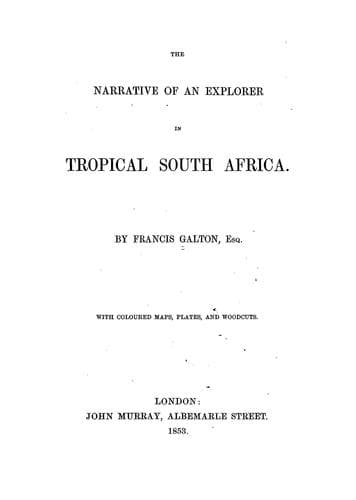
The narrative of an explorer in tropical South AfricaGalton, Francis
History
The narrative of an explorer in tropical South Africa
Galton, Francis
South Africa -- Description and travel
As we travelled on, some messengers met us. They were sent from the Chief
Kahikenè, who begged me to visit him. He lay at a large vley in front,
whither he had moved to meet me. The messenger brought a magnificent
black ox as a present from him; it was larger than any in my drove,
though I had some fine ones amongst them.
We had now finally lost sight of Jonker’s hills and all the broken
ground of the Swakop, the summits of whose highest mountains were below
us. We had mounted steadily up, and were journeying on a high plateau
6000 feet above the level of the sea, as measured by a boiling-point
thermometer. On this plateau Omatako, Koniati, and other hills stood.
Almost immediately after leaving a large tributary of the Swakop, we
came upon a river-bed, running in exactly the opposite direction, and
this we followed; it is called Okaroschekè, or “naked” river—the story
being, that one rainy season, when the water was flowing waist-high,
some Damara women tried to cross it to get at the berry-trees which
grew on the opposite bank, and stripped to do so, leaving their skin
aprons on the ground; when they were on the other side a torrent of
water came down which swept their aprons away, and left them without
clothing. The Damaras are very particular about wearing something,
however little it may be, and look upon complete nakedness as a great
disgrace. Another somewhat refined practice that they have is, that no
hunger will drive them to eat raw or even underdone meat. They have
numberless superstitions about meat, which are very troublesome: in the
first place, each tribe, or rather family, is prohibited from eating
cattle of certain colours, savages “who come from the sun” eschewing
sheep spotted in a particular way, which those “who come from the rain”
have no objection to. As there are five or six different “eandas” or
descents, and I had men from most of them with me, I could hardly ever
kill a sheep that everybody would eat; many were martyrs for a long
time to their consciences, but hunger converted them all at last. Goats
are an abomination to every Damara, whatever his eanda may be. Another
superstition is that meat is common property. Every slaughter is looked
upon as a kind of sacrifice or festal occasion. Damaras cannot conceive
that people should eat meat as their daily food. Their chiefs kill an ox
when a stranger comes, or half a dozen oxen on a birth or circumcision
feast, or any great event, and then everybody present shares the meat.
When I stayed near werfts I could not at first ensure my men getting food
enough to eat, for the strange Damaras came about them and begged their
share, “cursing” them if they refused. The curse is supposed to have a
withering and blighting effect. For this reason meat is never an article
of exchange at anything like its real value in Damara-land. A freshly
killed ox would not buy a live sheep. Damaras have a great respect,
almost reverence, for oxen. They keep them to look at, as we keep fallow
Public-domain text, read in full here on John Shaqi.
Reviews
Reviews
No reviews yet
Be the first to share your thoughts on this work.
Elsewhere in the archive
Join the Discussion
Join the discussion
Sign in to leave a comment or review.
Sign InorCreate an account