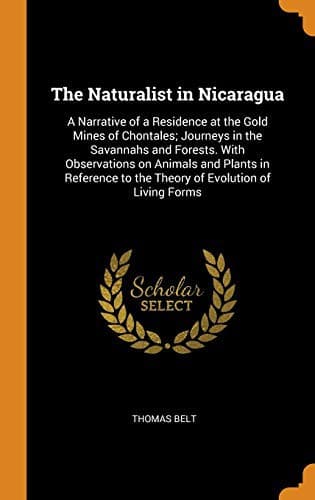
Natural history -- Nicaragua; Nicaragua -- Description and travel
Sometimes concealment is secured by the aid of adventitious
objects. Many lepidopterous larvae live in cases made of the
fragments of the substances upon which they feed; and certain
sea-urchins cover themselves so completely with pebbles, shells,
and so forth, that one can see nothing but a heap of little stones.
Perhaps, however, the most interesting instance is the crab
described by Mr. Bateson, which "takes a piece of weed in his two
chelae and, neither snatching nor biting it, deliberately tears it
across, as a man tears paper with his hands. He then puts one end
of it into his mouth, and after chewing it up, presumably to soften
it, takes it out in the chelae and rubs it firmly on his head or
legs until it is caught by the peculiar curved hairs which cover
them. If the piece of weed is not caught by the hairs, the crab
puts it back in his mouth and chews it up again. The whole
proceeding is most human and purposeful."
There is another class of colours in which not concealment but
conspicuousness is the object aimed at. Such colours are borne by
animals provided with formidable weapons of defence (the sting of
the wasp, for example), or possessed of an unpleasant taste or
offensive odour, and their foes come by experience to associate
this form of colouring with disagreeable qualities and avoid the
animals so marked. Belt was the first to account, in this way, for
the conspicuous colouration of the skunk; and it is now believed
that startling colours and conspicuous attitudes are intended to
assist the education of enemies by enabling them to learn and
remember the animals which are to be avoided. The explanation of
warning colours was devised by Mr. Wallace to account for the
brilliancy in the tints of certain caterpillars which birds find
disagreeable, and the subject has been principally studied by
experiments upon such caterpillars. But examples of warning colours
are recognised, among many others, in the contrasted black and
yellow of wasps, bees, and hornets, the bright red, black, and
yellow bands of the deadly coral snakes, and the brilliantly
coloured frog of Santo Domingo which hops unconcernedly about in
the daytime in his livery of red and blue--"for nothing will eat
him he well doth know."
But--and here comes in the principle to which the term "mimicry" is
now restricted--if warning colours are helpful to noxious animals,
then defenceless animals acquiring these colours will share in the
protection afforded by them. And so we find a deceptive similarity
between animals occurring in the same district, but not closely
related, in which the mimicked form is unpalatable or has an odour
repulsive to birds and lizards. It must, of course, be understood
that the mimicry is unconscious, the result, as in the cases of
cryptic resemblance, having been brought about by natural
selection--the less perfect the mimicry the more liable are the
individuals to be attacked, and the less chance have they of
reproducing their kind.
Public-domain text, read in full here on John Shaqi.
Reviews
Reviews
No reviews yet
Be the first to share your thoughts on this work.
Join the Discussion
Join the discussion
Sign in to leave a comment or review.
Sign InorCreate an account