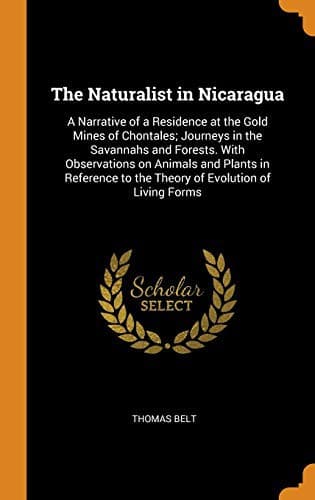
Natural history -- Nicaragua; Nicaragua -- Description and travel
Of more immediate interest to us are the "observations on animals
and plants in reference to the theory of evolution of living forms"
which the title-page announces as a part of the narrative, and
which indeed form the main portion of the work. Upon the
publication of Darwin's "Origin of Species" in 1859, Belt had
become an ardent evolutionist, and was henceforth always on the
look-out for facts in support of the theories which had breathed
such new life into biological studies. In Nicaragua he devoted
special attention to those wonderful protective resemblances,
especially among insects, which Bates had explained by his theory
of "Mimicry;" and as the subject crops up again and again in this
book, the non-scientific reader will find it helpful to have before
him an outline of the expanded and completed theory--though he
should be warned that some writers have been too much inclined to
attribute to "mimicry" any accidental resemblance between two
species. How far such accidental resemblances may be carried is
probably well illustrated by the bee, the spider, and the fly
orchis of our own downs and copses.
"Mimicry" proper is often confused with "protective resemblance,"
and it will be advisable to begin with the consideration of the
latter.
Concealment, while useful at times to all animals, is absolutely
essential to some; and it is wonderful in what different ways it is
attained. In cases of "cryptic resemblance to surroundings" the
shape, colouration, or markings are such as to conceal an animal by
rendering it difficult to distinguish from its immediate
environment. In most cases the effect is PROTECTIVE; but in snakes,
spiders, mantids, and other preying animals it is termed
AGGRESSIVE, since it enables these animals to stalk their prey
undetected. It is probable that this power, when possessed by a
vertebrate animal, nearly always bears the double meaning, as in
the green tree frog, where the colouration is protective so far as
it provides concealment from snakes, which are particularly fond of
these frogs, and aggressive in that it allows flies and other
insects to approach without suspicion.
Public-domain text, read in full here on John Shaqi.
Reviews
Reviews
No reviews yet
Be the first to share your thoughts on this work.
Join the Discussion
Join the discussion
Sign in to leave a comment or review.
Sign InorCreate an account