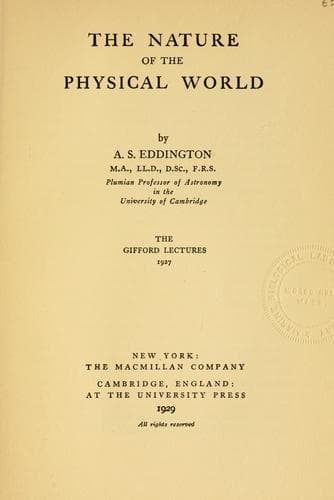
The nature of the physical worldEddington, Arthur Stanley, Sir
Philosophy
The nature of the physical world
Eddington, Arthur Stanley, Sir
Physics -- Philosophy; Science -- Philosophy
In order to measure from an event to an event with a clock
you must make an adjustment of the clock analogous to orienting a scale
along the line . What is this analogous adjustment? The purpose
in either case is to bring both and into the immediate
neighbourhood of the scale or clock. For the clock that means that
after experiencing the event it must travel with the appropriate
velocity needed to reach the locality of just at the moment
that happens. Thus the velocity of the clock is prescribed. One
further point should be noticed. After measuring with a scale from
[Pg 135]
to you can turn your scale round and measure from to
, obtaining the same result. But you cannot turn a clock round,
i.e. make it go backwards in time. That is important because it decides
which two sides are less than the third side. If you choose
the wrong pair the enunciation of the time proposition refers to an
impossible kind of measurement and becomes meaningless.
You remember the traveller (p. 39) who went off to a distant star
and returned absurdly young. He was a clock measuring two sides of a
time-triangle. He recorded less time than the stay-at-home observer
who was a clock measuring the third side. Need I defend my calling
him a clock? We are all of us clocks whose faces tell the passing
years. This comparison was simply an example of the geometrical
proposition about time-triangles (which in turn is a particular case
of Einstein’s law of longest track). The result is quite explicable in
the ordinary mechanical way. All the particles in the traveller’s body
increase in mass on account of his high velocity according to the law
already discussed and verified by experiment. This renders them more
sluggish, and the traveller lives more slowly according to terrestrial
time-reckoning. However, the fact that the result is reasonable and
explicable does not render it the less true as a proposition of time
geometry.
Public-domain text, read in full here on John Shaqi.
Reviews
Reviews
No reviews yet
Be the first to share your thoughts on this work.
Elsewhere in the archive
Join the Discussion
Join the discussion
Sign in to leave a comment or review.
Sign InorCreate an account