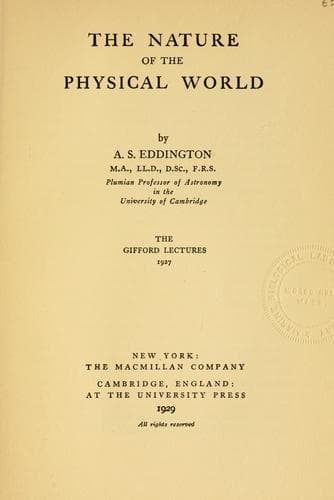
The nature of the physical worldEddington, Arthur Stanley, Sir
Philosophy
The nature of the physical world
Eddington, Arthur Stanley, Sir
Physics -- Philosophy; Science -- Philosophy
Our extension of geometry to include time as well as space will not be
a simple addition of an extra dimension to Euclidean geometry, because
the time propositions, though analogous, are not identical with those
which Euclid has given us for space alone. Actually the difference
between time geometry and space geometry is not very profound, and the
mathematician easily glides over it by a discrete use of the symbol
. We still call (rather loosely) the extended geometry
[Pg 136]
Euclidean; or, if it is necessary to emphasise the distinction, we call
it hyperbolic geometry. The term non-Euclidean geometry refers to a
more profound change, viz. that involved in the curvature of space and
time by which we now represent the phenomenon of gravitation. We start
with Euclidean geometry of space, and modify it in a comparatively
simple manner when the time-dimension is added; but that still leaves
gravitation to be reckoned with, and wherever gravitational effects
are observable it is an indication that the extended Euclidean
geometry is not quite exact, and the true geometry is a non-Euclidean
one—appropriate to a curved region as Euclidean geometry is to a flat
region.
Geometry and Mechanics. The point that deserves special
attention is that the proposition about time-triangles is a statement
as to the behaviour of clocks moving with different velocities. We have
usually regarded the behaviour of clocks as coming under the science
of mechanics. We found that it was impossible to confine geometry to
space alone, and we had to let it expand a little. It has expanded
with a vengeance and taken a big slice out of mechanics. There is no
stopping it, and bit by bit geometry has now swallowed up the whole of
mechanics. It has also made some tentative nibbles at electromagnetism.
An ideal shines in front of us, far ahead perhaps but irresistible,
that the whole of our knowledge of the physical world may be unified
into a single science which will perhaps be expressed in terms of
geometrical or quasi-geometrical conceptions. Why not? All the
knowledge is derived from measurements made with various instruments.
The instruments used in the different fields of inquiry are not
fundamentally unlike. There is no reason to regard the partitions of
[Pg 137]
the sciences made in the early stages of human thought as irremovable.
Public-domain text, read in full here on John Shaqi.
Reviews
Reviews
No reviews yet
Be the first to share your thoughts on this work.
Elsewhere in the archive
Join the Discussion
Join the discussion
Sign in to leave a comment or review.
Sign InorCreate an account