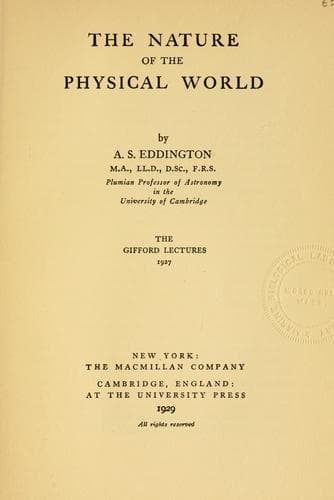
The nature of the physical worldEddington, Arthur Stanley, Sir
Philosophy
The nature of the physical world
Eddington, Arthur Stanley, Sir
Physics -- Philosophy; Science -- Philosophy
The long and short of it is that when the standard metre takes up a new
position or direction it measures itself against the directed radius
of the world in that region and direction, and takes up an extension
which is a definite fraction of the directed radius. I do not see
what else it could do. We picture the rod a little bewildered in its
new surroundings wondering how large it ought to be—how much of the
unfamiliar territory its boundaries ought to take in. It wants to do
just what it did before. Recollections of the chunk of space that it
formerly filled do not help, because there is nothing of the nature
of a landmark. The one thing it can recognise is a directed length
belonging to the region where it finds itself; so it makes itself the
same fraction of this directed length as it did before.
If the standard metre is always the same fraction of the directed
radius, the directed radius is always the same number of metres.
Accordingly the directed radius is made out to have the same length for
all positions and directions. Hence we have the law of gravitation.
When we felt surprise at finding as a law of Nature that the directed
radius of curvature was the same for all positions and directions,
we did not realise that our unit of length had already made itself a
constant fraction of the directed radius. The whole thing is a vicious
circle. The law of gravitation is—a put-up job.
[Pg 144]
This explanation introduces no new hypothesis. In saying that a
material system of standard specification always occupies a constant
fraction of the directed radius of the region where it is, we are
simply reiterating Einstein’s law of gravitation—stating it in the
inverse form. Leaving aside for the moment the question whether this
behaviour of the rod is to be expected or not, the law of gravitation
assures us that that is the behaviour. To see the force of the
explanation we must, however, realise the relativity of extension.
Extension which is not relative to something in the surroundings has
no meaning. Imagine yourself alone in the midst of nothingness, and
then try to tell me how large you are. The definiteness of extension of
the standard rod can only be a definiteness of its ratio to some other
extension. But we are speaking now of the extension of a rod placed
in empty space, so that every standard of reference has been removed
except extensions belonging to and implied by the metric of the region.
It follows that one such extension must appear from our measurements to
be constant everywhere (homogeneous and isotropic) on account of its
constant relation to what we have accepted as the unit of length.
Public-domain text, read in full here on John Shaqi.
Reviews
Reviews
No reviews yet
Be the first to share your thoughts on this work.
Elsewhere in the archive
Join the Discussion
Join the discussion
Sign in to leave a comment or review.
Sign InorCreate an account