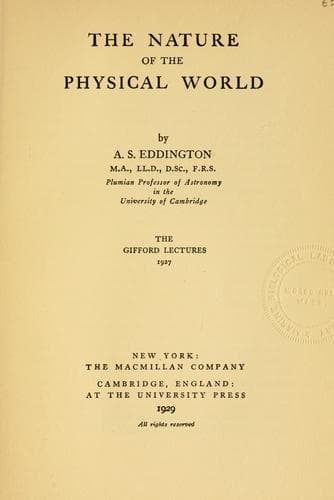
The nature of the physical worldEddington, Arthur Stanley, Sir
Philosophy
The nature of the physical world
Eddington, Arthur Stanley, Sir
Physics -- Philosophy; Science -- Philosophy
The fact that this directed radius which, one would think, might so
easily differ from point to point and from direction to direction, has
only one standard value in the world is Einstein’s law of gravitation.
From it we can by rigorous mathematical deduction work out the motions
of planets and predict, for example, the eclipses of the next thousand
years; for, as already explained, the law of gravitation includes
also the law of motion. Newton’s law of gravitation is an approximate
adaptation of it for practical calculation. Building up from the law
all is clear; but what lies beneath it? Why is there this unexpected
standardisation? That is what we must now inquire into.
Relativity of Length. There is no such thing as absolute length;
we can only express the length of one thing in terms of the length of
something else.[20] And so when we speak of the length of the directed
radius we mean its length compared with the standard metre scale.
Moreover, to make this comparison, the two lengths must lie alongside.
Comparison at a distance is as unthinkable as action at a distance;
more so, because comparison is a less vague conception than action. We
must either convey the standard metre to the site of the length we are
measuring, or we must use some device which, we are satisfied, will
give the same result as if we actually moved the metre rod.
Now if we transfer the metre rod to another point of space and time,
does it necessarily remain a metre long? Yes, of course it does; so
long as it is the standard of length it cannot be anything else but a
metre. But does it really remain the metre that it was? I do
not know what you mean by the question; there is nothing by reference
[Pg 142]
to which we could expose delinquencies of the standard rod, nothing
by reference to which we could conceive the nature of the supposed
delinquencies. Still the standard rod was chosen with considerable
care; its material was selected to fulfil certain conditions—to
be affected as little as possible by casual influences such as
temperature, strain or corrosion, in order that its extension might
depend only on the most essential characteristics of its surroundings,
present and past.[21] We cannot say that it was chosen to keep the same
absolute length since there is no such thing known; but it was chosen
[Pg 143]
so that it might not be prevented by casual influences from keeping
the same relative length—relative to what? Relative to some length
inalienably associated with the region in which it is placed. I can
conceive of no other answer. An example of such a length inalienably
associated with a region is the directed radius.
Public-domain text, read in full here on John Shaqi.
Reviews
Reviews
No reviews yet
Be the first to share your thoughts on this work.
Elsewhere in the archive
Join the Discussion
Join the discussion
Sign in to leave a comment or review.
Sign InorCreate an account