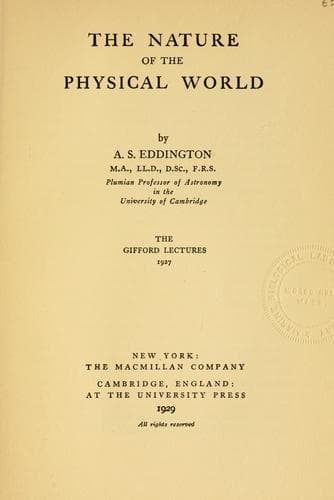
The nature of the physical worldEddington, Arthur Stanley, Sir
Philosophy
The nature of the physical world
Eddington, Arthur Stanley, Sir
Physics -- Philosophy; Science -- Philosophy
The conception of frames of space and time, and of the non-emptiness
of the world described as energy, momentum, etc., is bound up with
the survey by gross appliances. When they can no longer be supported
by such a survey, the conceptions melt away into meaninglessness. In
particular the interior of the atom could not conceivably be explored
by a gross survey. We cannot put a clock or a scale into the interior
of an atom. It cannot be too strongly insisted that the terms distance,
period of time, mass, energy, momentum, etc., cannot be used in a
description of an atom with the same meanings that they have in our
gross experience. The atomic physicist who uses these terms must
find his own meanings for them—must state the appliances which he
requisitions when he imagines them to be measured. It is sometimes
supposed that (in addition to electrical forces) there is a minute
gravitational attraction between an atomic nucleus and the satellite
electrons, obeying the same law as the gravitation between the sun
and its planets. The supposition seems to me fantastic; but it is
impossible to discuss it without any indication as to how the region
within the atom is supposed to have been measured up. Apart from such
measuring up the electron goes as it pleases “like the blessed gods”.
We have reached a point of great scientific and philosophic interest.
The ten principal coefficients of curvature of the world are not
strangers to us; they are already familiar in scientific discussion
under other names (energy, momentum, stress). This is comparable with a
famous turning-point in the development of electromagnetic theory. The
progress of the subject led to the consideration of waves of electric
and magnetic force travelling through the aether; then it flashed upon
[Pg 156]
Maxwell that these waves were not strangers but were already familiar
in our experience under the name of light. The method of identification
is the same. It is calculated that electromagnetic waves will have
just those properties which light is observed to have; so too it is
calculated that the ten coefficients of curvature have just those
properties which energy, momentum and stress are observed to have. We
refer here to physical properties only. No physical theory is expected
to explain why there is a particular kind of image in our minds
associated with light, nor why a conception of substance has arisen in
our minds in connection with those parts of the world containing mass.
Public-domain text, read in full here on John Shaqi.
Reviews
Reviews
No reviews yet
Be the first to share your thoughts on this work.
Elsewhere in the archive
Join the Discussion
Join the discussion
Sign in to leave a comment or review.
Sign InorCreate an account