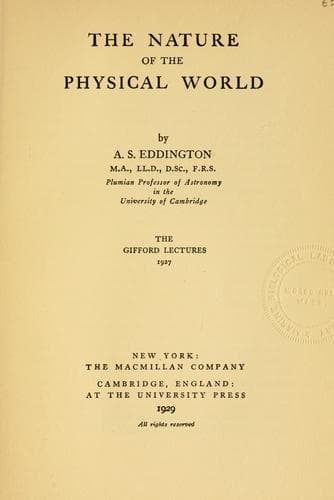
The nature of the physical worldEddington, Arthur Stanley, Sir
Philosophy
The nature of the physical world
Eddington, Arthur Stanley, Sir
Physics -- Philosophy; Science -- Philosophy
This leads to a considerable simplification, because identity replaces
causation. On the Newtonian theory no explanation of gravitation would
be considered complete unless it described the mechanism by which a
piece of matter gets a grip on the surrounding medium and makes it
the carrier of the gravitational influence radiating from the matter.
Nothing corresponding to this is required in the present theory. We do
not ask how mass gets a grip on space-time and causes the curvature
which our theory postulates. That would be as superfluous as to ask
how light gets a grip on the electromagnetic medium so as to cause it
to oscillate. The light is the oscillation; the mass is
the curvature. There is no causal effect to be attributed to mass;
still less is there any to be attributed to matter. The conception of
matter, which we associate with these regions of unusual contortion,
is a monument erected by the mind to mark the scene of conflict. When
you visit the site of a battle, do you ever ask how the monument that
commemorates it can have caused so much carnage?
The philosophic outcome of this identification will occupy us
[Pg 157]
considerably in later chapters. Before leaving the subject of
gravitation I wish to say a little about the meaning of space-curvature
and non-Euclidean geometry.
Non-Euclidean Geometry. I have been encouraging you to think
of space-time as curved; but I have been careful to speak of this
as a picture, not as a hypothesis. It is a graphical representation
of the things we are talking about which supplies us with insight
and guidance. What we glean from the picture can be expressed in a
more non-committal way by saying that space-time has non-Euclidean
geometry. The terms “curved space” and “non-Euclidean space” are used
practically synonymously; but they suggest rather different points
of view. When we were trying to conceive finite and unbounded space
(p. 81) the difficult step was the getting rid of the inside and the
outside of the hypersphere. There is a similar step in the transition
from curved space to non-Euclidean space—the dropping of all relations
to an external (and imaginary) scaffolding and the holding on to those
relations which exist within the space itself.
Public-domain text, read in full here on John Shaqi.
Reviews
Reviews
No reviews yet
Be the first to share your thoughts on this work.
Elsewhere in the archive
Join the Discussion
Join the discussion
Sign in to leave a comment or review.
Sign InorCreate an account