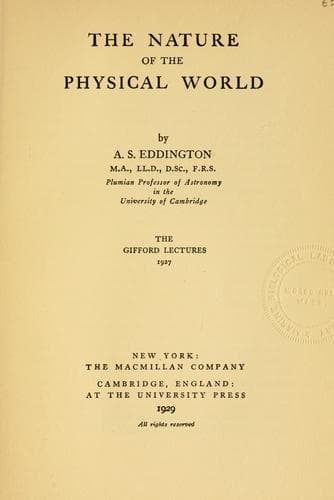
The nature of the physical worldEddington, Arthur Stanley, Sir
Philosophy
The nature of the physical world
Eddington, Arthur Stanley, Sir
Physics -- Philosophy; Science -- Philosophy
be regarded as one of the earliest subjects of inquiry in a physical
survey of our environment.) These lengths are a gateway through which
knowledge of the world around us is sought. Whether or not they will
remain prominent in the final picture of world-structure will transpire
as the research proceeds; we do not prejudge that. Actually we soon
find that space-lengths or time-lengths taken singly are relative,
and only a combination of them could be expected to appear even in
[Pg 161]
the humblest capacity in the ultimate world-structure. Meanwhile the
first step through the gateway takes us to the geometry obeyed by these
lengths—very nearly Euclidean, but actually non-Euclidean and, as
we have seen, a distinctive type of non-Euclidean geometry in which
the ten principal coefficients of curvature vanish. We have shown in
this chapter that the limitation is not arbitrary; it is a necessary
property of lengths expressed in terms of the extension of a material
standard, though it might have been surprising if it had occurred in
lengths defined otherwise. Must we stop to notice the interjection that
if we had meant something different by length we should have found a
different geometry? Certainly we should; and if we had meant something
different by electric force we should have found equations different
from Maxwell’s equations. Not only empirically but also by theoretical
reasoning, we reach the geometry which we do because our lengths mean
what they do.
I have too long delayed dealing with the criticism of the pure
mathematician who is under the impression that geometry is a subject
that belongs entirely to him. Each branch of experimental knowledge
tends to have associated with it a specialised body of mathematical
investigations. The pure mathematician, at first called in as
servant, presently likes to assert himself as master; the connexus of
mathematical propositions becomes for him the main subject, and he does
not ask permission from Nature when he wishes to vary or generalise
the original premises. Thus he can arrive at a geometry unhampered
by any restriction from actual space measures; a potential theory
unhampered by any question as to how gravitational and electrical
potentials really behave; a hydrodynamics of perfect fluids doing
[Pg 162]
things which it would be contrary to the nature of any material fluid
to do. But it seems to be only in geometry that he has forgotten
that there ever was a physical subject of the same name, and even
resents the application of the name to anything but his network
of abstract mathematics. I do not think it can be disputed that,
both etymologically and traditionally, geometry is the science of
measurement of the space around us; and however much the mathematical
superstructure may now overweigh the observational basis, it is
properly speaking an experimental science. This is fully recognised
in the “reformed” teaching of geometry in schools; boys are taught to
Public-domain text, read in full here on John Shaqi.
Reviews
Reviews
No reviews yet
Be the first to share your thoughts on this work.
Elsewhere in the archive
Join the Discussion
Join the discussion
Sign in to leave a comment or review.
Sign InorCreate an account