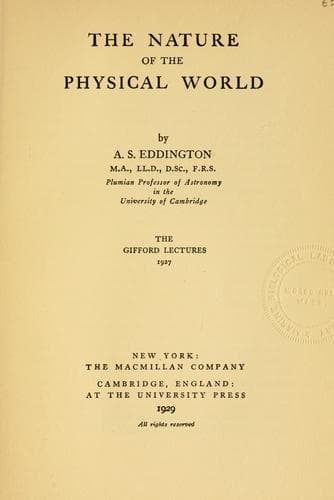
The nature of the physical worldEddington, Arthur Stanley, Sir
Philosophy
The nature of the physical world
Eddington, Arthur Stanley, Sir
Physics -- Philosophy; Science -- Philosophy
verify by measurement that certain of the geometrical propositions are
true or nearly true. No one questions the advantage of an unfettered
development of geometry as a pure mathematical subject; but only in
so far as this subject is linked to the quantities arising out of
observation and measurement, will it find mention in a discussion of
the Nature of the Physical World.
[19]
Cylindrical curvature of the world has nothing to do with
gravitation, nor so far as we know with any other phenomenon.
Anything drawn on the surface of a cylinder can be unrolled into a
flat map without distortion, but the curvature introduced in the
last chapter was intended to account for the
distortion which appears in our customary flat map; it is therefore
curvature of the type exemplified by a sphere, not a cylinder.
[20]
This relativity with respect to a standard unit is, of
course, additional to and independent of the relativity with respect to
the observer’s motion treated in chapter II.
[21]
In so far as these casual influences are not entirely
eliminated by the selection of material and the precautions in using
the rod, appropriate corrections must be applied. But the rod must
not be corrected for essential characteristics of the space it is
measuring. We correct the reading of a voltmeter for temperature,
but it would be nonsensical to correct it for effects of the applied
voltage. The distinction between casual and essential influences—those
to be eliminated and those to be left in—depends on the intention of
the measurements. The measuring rod is intended for surveying space,
and the essential characteristic of space is “metric”. It would be
absurd to correct the readings of our scale to the values they would
have had if the space had some other metric. The region of the world
to which the metric refers may also contain an electric field; this
will be regarded as a casual characteristic since the measuring rod
is not intended for surveying electric fields. I do not mean that
from a broader standpoint the electric field is any less essential to
the region than its peculiar metric. It would be hard to say in what
sense it would remain the same region if any of its qualities were
other than they actually are. This point does not trouble us here,
because there are vast regions of the world practically empty of all
characteristics except metric, and it is to these that the law of
gravitation is applied both in theory and in practice. It has seemed,
however, desirable to dwell on this distinction between essential and
casual characteristics because there are some who, knowing that we
cannot avoid in all circumstances corrections for casual influences,
regard that as license to adopt any arbitrary system of corrections—a
procedure which would merely have the effect of concealing what the
measures can teach us about essential characteristics.
[22]
A. N. Whitehead, The Principle of Relativity,
Preface.
Public-domain text, read in full here on John Shaqi.
Reviews
Reviews
No reviews yet
Be the first to share your thoughts on this work.
Elsewhere in the archive
Join the Discussion
Join the discussion
Sign in to leave a comment or review.
Sign InorCreate an account