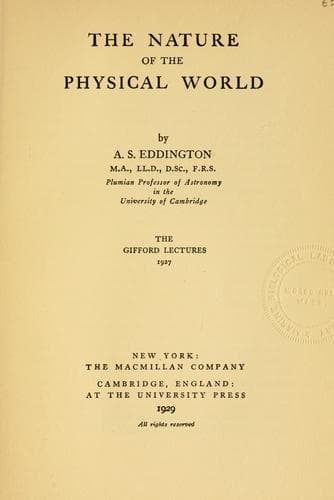
The nature of the physical worldEddington, Arthur Stanley, Sir
Philosophy
The nature of the physical world
Eddington, Arthur Stanley, Sir
Physics -- Philosophy; Science -- Philosophy
Attempts have been made to find the whole number of stars by a risky
extrapolation of these counts, and totals ranging from 3000 to 30,000
millions are sometimes quoted. But the difficulty is that the part of
the stellar universe which we mainly survey is a local condensation or
star-cloud forming part of a much greater system. In certain directions
in the sky our telescopes penetrate to the limits of the system, but in
other directions the extent is too great for us to fathom. The Milky
Way, which on a dark night forms a gleaming belt round the sky, shows
the direction in which there lie stars behind stars until vision fails.
This great flattened distribution is called the Galactic System. It
forms a disc of thickness small compared to its a real extent. It is
[Pg 164]
partly broken up into subordinate condensations, which are probably
coiled in spiral form like the spiral nebulae which are observed in
great numbers in the heavens. The centre of the galactic system lies
somewhere in the direction of the constellation Sagittarius; it is
hidden from us not only by great distance but also to some extent by
tracts of obscuring matter (dark nebulosity) which cuts off the light
of the stars behind.
We must distinguish then between our local star-cloud and the great
galactic system of which it is a part. Mainly (but not exclusively) the
star-counts relate to the local star-cloud, and it is this which the
largest telescopes are beginning to exhaust. It too has a flattened
form—flattened nearly in the same plane as the galactic system. If
the galactic system is compared to a disc, the local star-cloud may be
compared to a bun, its thickness being about one-third of its lateral
extension. Its size is such that light takes at least 2000 years to
cross from one side to the other; this measurement is necessarily
rough because it relates to a vague condensation which is probably not
sharply separated from other contiguous condensations. The extent of
the whole spiral is of the order 100,000 light years. It can scarcely
be doubted that the flattened form of the system is due to rapid
rotation, and indeed there is direct evidence of strong rotational
velocity; but it is one of the unexplained mysteries of evolution that
nearly all celestial bodies have come to be endowed with fast rotation.
Public-domain text, read in full here on John Shaqi.
Reviews
Reviews
No reviews yet
Be the first to share your thoughts on this work.
Elsewhere in the archive
Join the Discussion
Join the discussion
Sign in to leave a comment or review.
Sign InorCreate an account