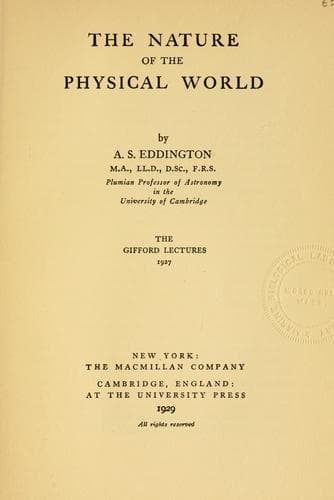
The nature of the physical worldEddington, Arthur Stanley, Sir
Philosophy
The nature of the physical world
Eddington, Arthur Stanley, Sir
Physics -- Philosophy; Science -- Philosophy
Amid this great population the sun is a humble unit. It is a very
ordinary star about midway in the scale of brilliancy. We know of
stars which give at least 10,000 times the light of the sun; we know
also of stars which give ¹⁄₁₀₀₀₀ of its light. But those of inferior
light greatly outnumber those of superior light. In mass, in surface
[Pg 165]
temperature, in bulk, the sun belongs to a very common class of stars;
its speed of motion is near the average; it shows none of the more
conspicuous phenomena such as variability which excite the attention
of astronomers. In the community of stars the sun corresponds to a
respectable middle-class citizen. It happens to be quite near the
centre of the local star-cloud; but this apparently favoured position
is discounted by the fact that the star-cloud itself is placed very
eccentrically in relation to the galactic system, being in fact near
the confines of it. We cannot claim to be at the hub of the universe.
The contemplation of the galaxy impresses us with the insignificance
of our own little world; but we have to go still lower in the valley
of humiliation. The galactic system is one among a million or more
spiral nebulae. There seems now to be no doubt that, as has long been
suspected, the spiral nebulae are “island universes” detached from our
own. They too are great systems of stars—or systems in the process of
developing into stars—built on the same disc-like plan. We see some
of them edgeways and can appreciate the flatness of the disc; others
are broadside on and show the arrangement of the condensations in the
form of a double spiral. Many show the effects of dark nebulosity
breaking into the regularity-and blotting out the star-light. In a
few of the nearest spirals it is possible to detect the brightest of
the stars individually; variable stars and novae (or “new stars”) are
observed as in our own system. From the apparent magnitudes of the
stars of recognisable character (especially the Cepheid variables) it
is possible to judge the distance. The nearest spiral nebula is 850,000
light years away.
[Pg 166]
From the small amount of data yet collected it would seem that our
own nebula or galactic system is exceptionally large; it is even
suggested that if the spiral nebulae are “islands” the galactic system
is a “continent”. But we can scarcely venture to claim premier rank
without much stronger evidence. At all events these other universes are
aggregations of the order of 100 million stars.
Public-domain text, read in full here on John Shaqi.
Reviews
Reviews
No reviews yet
Be the first to share your thoughts on this work.
Elsewhere in the archive
Join the Discussion
Join the discussion
Sign in to leave a comment or review.
Sign InorCreate an account