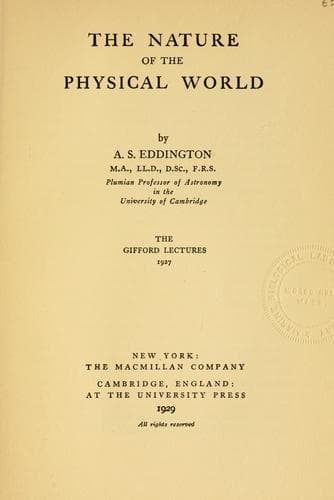
The nature of the physical worldEddington, Arthur Stanley, Sir
Philosophy
The nature of the physical world
Eddington, Arthur Stanley, Sir
Physics -- Philosophy; Science -- Philosophy
It is idle to guess the forms that life might take in conditions
differing from those of our planet. If I have rightly understood the
view of palaeontologists, mammalian life is the third terrestrial
dynasty—Nature’s third attempt to evolve an order of life sufficiently
flexible to changing conditions and fitted to dominate the earth.
Minor details in the balance of circumstances must greatly affect the
possibility of life and the type of organism destined to prevail. Some
critical branch-point in the course of evolution must be negotiated
before life can rise to the level of consciousness. All this is remote
from the astronomer’s line of study. To avoid endless conjecture I
shall assume that the required conditions of habitability are not
unlike those on the earth, and that if such conditions obtain life will
automatically make its appearance.
We survey first the planets of the solar system; of these only Venus
and Mars seem at all eligible. Venus, so far as we know, would be
well adapted for life similar to ours. It is about the same size as
the earth, nearer the sun but probably not warmer, and it possesses
an atmosphere of satisfactory density. Spectroscopic observation has
unexpectedly failed to give any indication of oxygen in the upper
atmosphere and thus suggests a doubt as to whether free oxygen exists
on the planet; but at present we hesitate to draw so definite an
inference. If transplanted to Venus we might perhaps continue to live
without much derangement of habit—except that I personally would
have to find a new profession, since Venus is not a good place for
astronomers. It is completely covered with cloud or mist. For this
[Pg 171]
reason no definite surface markings can be made out, and it is still
uncertain how fast it rotates on its axis and in which direction the
axis lies. One curious theory may be mentioned though it should perhaps
not be taken too seriously. It is thought by some that the great cavity
occupied by the Pacific Ocean is a scar left by the moon when it was
first disrupted from the earth. Evidently this cavity fulfils an
important function in draining away superfluous water, and if it were
filled up practically all the continental area would be submerged. Thus
indirectly the existence of dry land is bound up with the existence of
the moon. But Venus has no moon, and since it seems to be similar to
the earth in other respects, it may perhaps be inferred that it is a
world which is all ocean—where fishes are supreme. The suggestion at
any rate serves to remind us that the destinies of organic life may be
determined by what are at first sight irrelevant accidents.
Public-domain text, read in full here on John Shaqi.
Reviews
Reviews
No reviews yet
Be the first to share your thoughts on this work.
Elsewhere in the archive
Join the Discussion
Join the discussion
Sign in to leave a comment or review.
Sign InorCreate an account