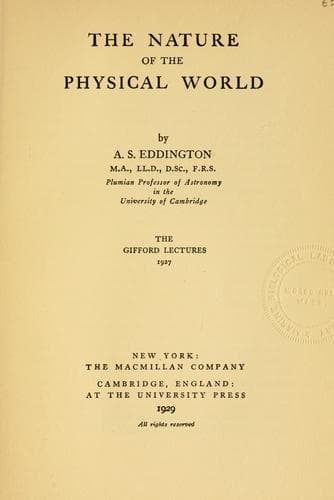
The nature of the physical worldEddington, Arthur Stanley, Sir
Philosophy
The nature of the physical world
Eddington, Arthur Stanley, Sir
Physics -- Philosophy; Science -- Philosophy
The sun is an ordinary star and the earth is an ordinary planet, but
the moon is not an ordinary satellite. No other known satellite is
anything like so large in proportion to the planet which it attends.
The moon contains about ¹⁄₈₀ part of the mass of the earth which
seems a small ratio; but it is abnormally great compared with other
satellites. The next highest ratio is found in the system of Saturn
whose largest satellite Titan has ¹⁄₄₀₀₀ of the planet’s mass. Very
special circumstances must have occurred in the history of the earth to
have led to the breaking away of so unusual a fraction of the mass. The
explanation proposed by Sir George Darwin, which is still regarded as
most probable, is that a resonance in period occurred between the solar
tides and the natural free period of vibration of the globe of the
[Pg 172]
earth. The tidal deformation of the earth thus grew to large amplitude,
ending in a cataclysm which separated the great lump of material that
formed the moon. Other planets escaped this dangerous coincidence of
period, and their satellites separated by more normal development. If
ever I meet a being who has lived in another world, I shall feel very
humble in most respects, but I expect to be able to boast a little
about the moon.
Mars is the only planet whose solid surface can be seen and studied;
and it tempts us to consider the possibility of life in more detail.
Its smaller size leads to considerably different conditions; but the
two essentials, air and water, are both present though scanty. The
Martian atmosphere is thinner than our own but it is perhaps adequate.
It has been proved to contain oxygen. There is no ocean; the surface
markings represent, not sea and land, but red desert and darker ground
which is perhaps moist and fertile. A conspicuous feature is the
white cap covering the pole which is clearly a deposit of snow; it
must be quite shallow since it melts away completely in the summer.
Photographs show from time to time indubitable clouds which blot out
temporarily large areas of surface detail; clear weather, however, is
more usual. The air, if cloudless, is slightly hazy. W. H. Wright has
shown this very convincingly by comparing photographs taken with light
of different wave-lengths. Light of short wave-length is much scattered
by haze and accordingly the ordinary photographs are disappointingly
blurry. Much sharper surface-detail is shown when visual yellow light
is employed (a yellow screen being commonly used to adapt visual
telescopes for photography); being of longer wave-length the visual
rays penetrate the haze more easily.[29] Still clearer detail is
[Pg 173]
obtained by photographing with the long infra-red waves.
Public-domain text, read in full here on John Shaqi.
Reviews
Reviews
No reviews yet
Be the first to share your thoughts on this work.
Elsewhere in the archive
Join the Discussion
Join the discussion
Sign in to leave a comment or review.
Sign InorCreate an account