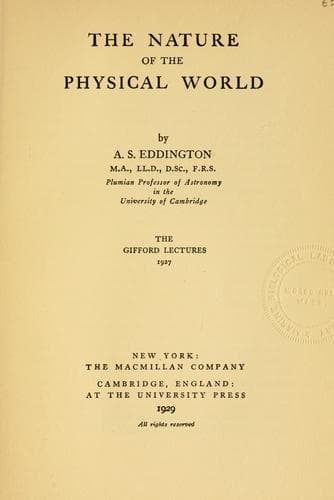
The nature of the physical worldEddington, Arthur Stanley, Sir
Philosophy
The nature of the physical world
Eddington, Arthur Stanley, Sir
Physics -- Philosophy; Science -- Philosophy
However doubtful this conclusion as to the rarity of solar systems
may be, it is a useful corrective to the view too facilely adopted
which looks upon every star as a likely minister to life. We know the
prodigality of Nature. How many acorns are scattered for one that grows
to an oak? And need she be more careful of her stars than of her
[Pg 178]
acorns? If indeed she has no grander aim than to provide a home for her
greatest experiment, Man, it would be just like her methods to scatter
a million stars whereof one might haply achieve her purpose.
The number of possible abodes of life severely restricted in this
way at the outset may no doubt be winnowed down further. On our
house-hunting expedition we shall find it necessary to reject many
apparently eligible mansions on points of detail. Trivial circumstances
may decide whether organic forms originate at all; further conditions
may decide whether life ascends to a complexity like ours or remains in
a lower form. I presume, however, that at the end of the weeding out
there will be left a few rival earths dotted here and there about the
universe.
A further point arises if we have especially in mind contemporaneous
life. The time during which man has been on the earth is extremely
small compared with the age of the earth or of the sun. There is no
obvious physical reason why, having once arrived, man should not
continue to populate the earth for another ten billion years or so;
but—well, can you contemplate it? Assuming that the stage of highly
developed life is a very small fraction of the inorganic history of
the star, the rival earths are in general places where conscious life
has already vanished or is yet to come. I do not think that the whole
purpose of the Creation has been staked on the one planet where we
live; and in the long run we cannot deem ourselves the only race that
has been or will be gifted with the mystery of consciousness. But I
feel inclined to claim that at the present time our race is
supreme; and not one of the profusion of stars in their myriad clusters
looks down on scenes comparable to those which are passing beneath the
rays of the sun.
[28]
A very much larger radius of space ( light
years) has recently been proposed by Hubble; but the basis of his
calculation, though concerned with spiral nebulae, is different and to
my mind unacceptable. It rests on an earlier theory of closed space
proposed by Einstein which has generally been regarded as superseded.
The theory given above (due to W. de Sitter) is, of course, very
speculative, but it is the only clue we possess as to the dimensions of
space.
[29]
It seems to have been a fortunate circumstance that the
pioneers of Martian photography had no suitable photographic telescopes
and had to adapt visual telescopes—thus employing visual (yellow)
light which, as it turned out, was essential for good results.
Public-domain text, read in full here on John Shaqi.
Reviews
Reviews
No reviews yet
Be the first to share your thoughts on this work.
Elsewhere in the archive
Join the Discussion
Join the discussion
Sign in to leave a comment or review.
Sign InorCreate an account