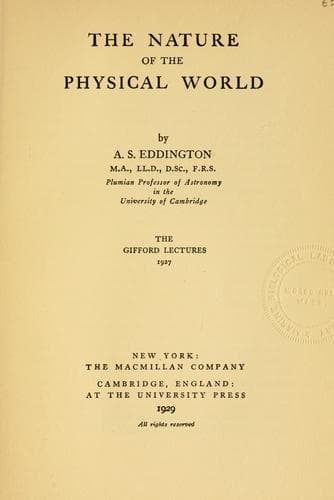
The nature of the physical worldEddington, Arthur Stanley, Sir
Philosophy
The nature of the physical world
Eddington, Arthur Stanley, Sir
Physics -- Philosophy; Science -- Philosophy
The most obvious cause of division is excessive rotation. As the
gaseous globe contracts it spins fast and faster until a time may
come when it can no longer hold together, and some kind of relief
must be found. According to the nebular hypothesis of Laplace the
sun gained relief by throwing off successively rings of matter which
have formed the planets. But were it not for this one instance of a
planetary system which is known to us, we should have concluded from
the thousands of double stars in the sky that the common consequence of
excessive rotation is to divide the star into two bodies of equal rank.
It might still be held that the ejection of a planetary system and the
fission into a double star are alternative solutions of the problem
arising from excessive rotation, the star taking one course or the
other according to circumstances. We know of myriads of double stars
and of only one planetary system; but in any case it is beyond our
power to detect other planetary systems if they exist. We can only
appeal to the results of theoretical study of rotating masses of
gas; the work presents many complications and the results may not be
final; but the researches of Sir J. H. Jeans lead to the conclusion
that rotational break-up produces a double star and never a system of
planets. The solar system is not the typical product of development of
a star; it is not even a common variety of development; it is a freak.
[Pg 177]
By elimination of alternatives it appears that a configuration
resembling the solar system would only be formed if at a certain stage
of condensation an unusual accident had occurred. According to Jeans
the accident was the close approach of another star casually pursuing
its way through space. This star must have passed within a distance not
far outside the orbit of Neptune; it must not have passed too rapidly,
but have slowly overtaken or been overtaken by the sun. By tidal
distortion it raised big protuberances on the sun, and caused it to
spurt out filaments of matter which have condensed to form the planets.
That was more than a thousand million years ago. The intruding star
has since gone on its way and mingled with the others; its legacy of a
system of planets remains, including a globe habitable by man.
Even in the long life of a star encounters of this kind must be
extremely rare. The density of distribution of stars in space has been
compared to that of twenty tennis-balls roaming the whole interior of
the earth. The accident that gave birth to the solar system may be
compared to the casual approach of two of these balls within a few
yards of one another. The data are too vague to give any definite
estimate of the odds against this occurrence, but I should judge that
perhaps not one in a hundred millions of stars can have undergone this
experience in the right stage and conditions to result in the formation
of a system of planets.
Public-domain text, read in full here on John Shaqi.
Reviews
Reviews
No reviews yet
Be the first to share your thoughts on this work.
Elsewhere in the archive
Join the Discussion
Join the discussion
Sign in to leave a comment or review.
Sign InorCreate an account