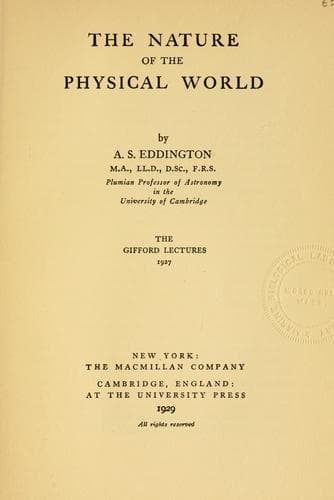
The nature of the physical worldEddington, Arthur Stanley, Sir
Philosophy
The nature of the physical world
Eddington, Arthur Stanley, Sir
Physics -- Philosophy; Science -- Philosophy
But it does not seem quite so strange when we look at it in the
absolute four-dimensional world. Quantities such as energy, which we
think of as existing at an instant, belong to three-dimensional space,
and they need to be multiplied by a duration to give them a thickness
before they can be put into the four-dimensional world. Consider a
portion of space, say Great Britain; we should describe the amount of
humanity in it as 40 million men. But consider a portion of space-time,
say Great Britain between 1915 and 1925; we must describe the amount of
humanity in it as 400 million man-years. To describe the human
content of the world from a space-time point of view we have to take
a unit which is limited not only in space but in time. Similarly if
some other kind of content of space is described as so many ergs, the
corresponding content of a region of space-time will be described as so
many erg-seconds.
We call this quantity in the four-dimensional world which is the
analogue or adaptation of energy in the three-dimensional world by
the technical name action. The name does not seem to have any
special appropriateness, but we have to accept it. Erg-seconds or
action belongs to Minkowski’s world which is common to all observers,
and so it is absolute. It is one of the very few absolute quantities
noticed in pre-relativity physics. Except for action and entropy (which
belongs to an entirely different class of physical conceptions)
[Pg 181]
all the quantities prominent in pre-relativity physics refer to the
three-dimensional sections which are different for different observers.
Public-domain text, read in full here on John Shaqi.
Reviews
Reviews
No reviews yet
Be the first to share your thoughts on this work.
Elsewhere in the archive
Join the Discussion
Join the discussion
Sign in to leave a comment or review.
Sign InorCreate an account