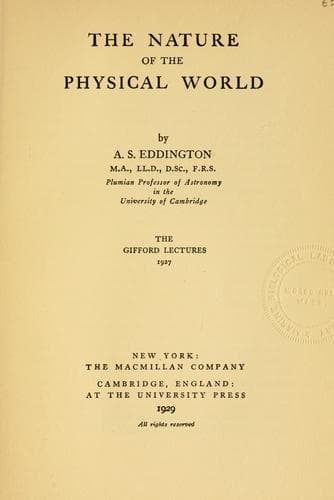
The nature of the physical worldEddington, Arthur Stanley, Sir
Philosophy
The nature of the physical world
Eddington, Arthur Stanley, Sir
Physics -- Philosophy; Science -- Philosophy
Long before the theory of relativity showed us that action was likely
to have a special importance in the scheme of Nature on account of its
absoluteness, long before the particular piece of action h began to
turn up in experiments, the investigators of theoretical dynamics were
making great use of action. It was especially the work of Sir William
Hamilton which brought it to the fore; and since then very extensive
theoretical developments of dynamics have been made on this basis. I
need only refer to the standard treatise on Analytical Dynamics by your
own (Edinburgh) Professor[31], which fairly reeks of it. It was not
difficult to appreciate the fundamental importance and significance of
the main principle; but it must be confessed that to the non-specialist
the interest of the more elaborate developments did not seem very
obvious—except as an ingenious way of making easy things difficult.
In the end the instinct which led to these researches has justified
itself emphatically. To follow any of the progress in the quantum
theory of the atom since about 1917, it is necessary to have plunged
rather deeply into the Hamiltonian theory of dynamics. It is remarkable
that just as Einstein found ready prepared by the mathematicians
the Tensor Calculus which he needed for developing his great theory
of gravitation, so the quantum physicists found ready for them an
extensive action-theory of dynamics without which they could not have
made headway.
But neither the absolute importance of action in the four-dimensional
world, nor its earlier prominence in Hamiltonian dynamics, prepares
[Pg 182]
us for the discovery that a particular lump of it can have a
special importance. And yet a lump of standard size
is continually turning up experimentally. It is
all very well to say that we must think of action as atomic and regard
this lump as the atom of action. We cannot do it. We have been trying
hard for the last ten years. Our present picture of the world shows
action in a form quite incompatible with this kind of atomic structure,
and the picture will have to be redrawn. There must in fact be a
radical change in the fundamental conceptions on which our scheme of
physics is founded; the problem is to discover the particular change
required. Since 1925 new ideas have been brought into the subject which
seem to make the deadlock less complete, and give us an inkling of the
nature of the revolution that must come; but there has been no general
solution of the difficulty. The new ideas will be the subject of the
next chapter. Here it seems best to limit ourselves to the standpoint
of 1925, except at the very end of the chapter, where we prepare for
the transition.
Public-domain text, read in full here on John Shaqi.
Reviews
Reviews
No reviews yet
Be the first to share your thoughts on this work.
Elsewhere in the archive
Join the Discussion
Join the discussion
Sign in to leave a comment or review.
Sign InorCreate an account