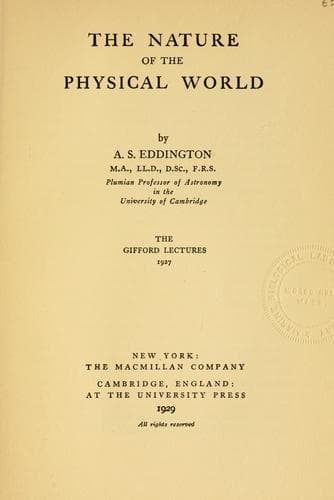
The nature of the physical worldEddington, Arthur Stanley, Sir
Philosophy
The nature of the physical world
Eddington, Arthur Stanley, Sir
Physics -- Philosophy; Science -- Philosophy
Attempts to account for this phenomenon follow two main devices which
we may describe as the “collection-box” theory and the “sweepstake”
theory, respectively. Making no effort to translate them into
scientific language, they amount to this: In the first the atom holds
a collection-box into which each arriving group of waves pays a very
small contribution; when the amount in the box reaches a whole
[Pg 187]
quantum, it enters the atom. In the second the atom uses the small
fraction of a quantum offered to it to buy a ticket in a sweepstake in
which the prizes are whole quanta; some of the atoms will win whole
quanta which they can absorb, and it is these winning atoms in our
retina which tell us of the existence of Sirius.
The collection-box explanation is not tenable. As Jeans once said,
not only does the quantum theory forbid us to kill two birds with one
stone; it will not even let us kill one bird with two stones. I cannot
go fully into the reasons against this theory, but may illustrate one
or two of the difficulties. One serious difficulty would arise from the
half-filled collection-boxes. We shall see this more easily if, instead
of atoms, we consider molecules which also absorb only full quanta. A
molecule might begin to collect the various kinds of light which it can
absorb, but before it has collected a quantum of any one kind it takes
part in a chemical reaction. New compounds are formed which no longer
absorb the old kinds of light; they have entirely different absorption
spectra. They would have to start afresh to collect the corresponding
kinds of light. What is to be done with the old accumulations now
useless, since they can never be completed? One thing is certain; they
are not tipped out into the aether when the chemical change occurs.
A phenomenon which seems directly opposed to any kind of collection-box
explanation is the photoelectric effect. When light shines on
metallic films of sodium, potassium, rubidium, etc., free electrons
are discharged from the film. They fly away at high speed, and
it is possible to measure experimentally their speed or energy.
Undoubtedly it is the incident light which provides the energy of
[Pg 188]
these explosions, but the phenomenon is governed by a remarkable rule.
Firstly, the speed of the electrons is not increased by using more
powerful light. Concentration of the light produces more explosions but
not more powerful explosions. Secondly, the speed is increased by using
bluer light, i.e. light of shorter period. For example, the feeble
light reaching us from Sirius will cause more powerful ejections of
electrons than full sunlight, because Sirius is bluer than the sun; the
remoteness of Sirius does not weaken the ejections though it reduces
their number.
Public-domain text, read in full here on John Shaqi.
Reviews
Reviews
No reviews yet
Be the first to share your thoughts on this work.
Elsewhere in the archive
Join the Discussion
Join the discussion
Sign in to leave a comment or review.
Sign InorCreate an account