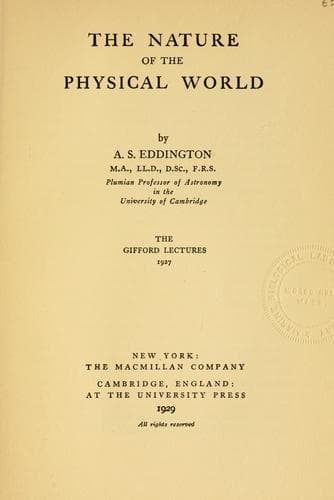
The nature of the physical worldEddington, Arthur Stanley, Sir
Philosophy
The nature of the physical world
Eddington, Arthur Stanley, Sir
Physics -- Philosophy; Science -- Philosophy
This is a straightforward quantum phenomenon. Every electron flying
out of the metal has picked up just one quantum from the incident
light. Since the -rule associates the greater energy with the
shorter vibration period, bluer light gives the more intense energy.
Experiments show that (after deducting a constant “threshold” energy
used up in extricating the electron from the film) each electron
comes out with a kinetic energy equal to the energy of the quantum of
incident light.
The film can be prepared in the dark; but on exposure to feeble
light electrons immediately begin to fly out before any of the
collection-boxes could have been filled by fair means. Nor can we
appeal to any trigger action of the light releasing an electron already
loaded up with energy for its journey; it is the nature of the light
which settles the amount of the load. The light calls the tune,
therefore the light must pay the piper. Only classical theory does
not provide light with a pocket to pay from.
It is always difficult to make a fence of objections so thorough as to
rule out all progress along a certain line of explanation. But even if
it is still possible to wriggle on, there comes a time when one begins
[Pg 189]
to perceive that the evasions are far-fetched. If we have any instinct
that can recognise a fundamental law of Nature when it sees one, that
instinct tells us that the interaction of radiation and matter in
single quanta is something lying at the root of world-structure and not
a casual detail in the mechanism of the atom. Accordingly we turn to
the “sweepstake” theory, which sees in this phenomenon a starting-point
for a radical revision of the classical conceptions.
Suppose that the light-waves are of such intensity that, according to
the usual reckoning of their energy, one-millionth of a quantum is
brought within range of each atom. The unexpected phenomenon is that
instead of each atom absorbing one-millionth of a quantum, one atom
out of every million absorbs a whole quantum. That whole quanta are
absorbed is shown by the photoelectric experiments already described,
since each of the issuing electrons has managed to secure the energy of
a whole quantum.
It would seem that what the light-waves were really bearing within
reach of each atom was not a millionth of a quantum but a millionth
chance of securing a whole quantum. The wave-theory of light
pictures and describes something evenly distributed over the whole
wave-front which has usually been identified with energy. Owing to
well-established phenomena such as interference and diffraction it
seems impossible to deny this uniformity, but we must give it another
interpretation; it is a uniform chance of energy. Following the
rather old-fashioned definition of energy as “capacity for doing work”
the waves carry over their whole front a uniform chance of doing work.
It is the propagation of a chance which the wave-theory studies.
[Pg 190]
Public-domain text, read in full here on John Shaqi.
Reviews
Reviews
No reviews yet
Be the first to share your thoughts on this work.
Elsewhere in the archive
Join the Discussion
Join the discussion
Sign in to leave a comment or review.
Sign InorCreate an account