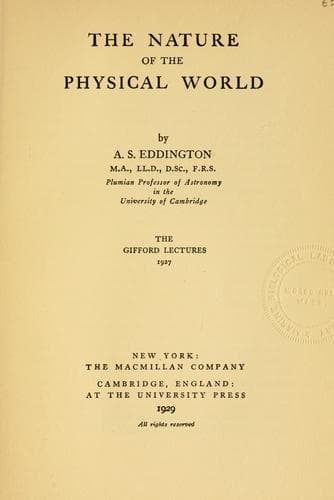
The nature of the physical worldEddington, Arthur Stanley, Sir
Philosophy
The nature of the physical world
Eddington, Arthur Stanley, Sir
Physics -- Philosophy; Science -- Philosophy
Different views may be held as to how the prize-drawing is conducted on
the sweepstake theory. Some hold that the lucky part of the wave-front
is already marked before the atom is reached. In addition to the
propagation of uniform waves the propagation of a photon or “ray of
luck” is involved. This seems to me out of keeping with the general
trend of the modern quantum theory; and although most authorities now
take this view, which is said to be indicated definitely by certain
experiments, I do not place much reliance on the stability of this
opinion.
Theory of the Atom. We return now to further experimental
knowledge of quanta. The mysterious quantity crops up inside the
atom as well as outside it. Let us take the simplest of all atoms,
namely, the hydrogen atom. This consists of a proton and an electron,
that is to say a unit charge of positive electricity and a unit charge
of negative electricity. The proton carries nearly all the mass of the
atom and remains rock-like at the centre, whilst the nimble electron
moves round in a circular or elliptic orbit under the inverse-square
law of attraction between them. The system is thus very like a sun and
a planet. But whereas in the solar system the planet’s orbit may be
of any size and any eccentricity, the electron’s orbit is restricted
to a definite series of sizes and shapes. There is nothing in the
classical theory of electromagnetism to impose such a restriction; but
the restriction exists, and the law imposing it has been discovered. It
arises because the atom is arranging to make something in its interior
equal to . The intermediate orbits are excluded because they would
involve fractions of , and cannot be divided.
But there is one relaxation. When wave-energy is sent out from or
[Pg 191]
taken into the atom, the amount and period must correspond exactly
to . But as regards its internal arrangements the atom has no
objection to , , , etc.; it only insists that
fractions shall be excluded. That is why there are many alternative
orbits for the electron corresponding to different integral multipliers
of . We call these multipliers quantum numbers, and speak
of 1-quantum orbits, 2-quantum orbits, etc. I will not enter here into
the exact definition of what it is that has to be an exact multiple of
; but it is something which, viewed in the four-dimensional world,
is at once seen to be action though this may not be so apparent when we
view it in the ordinary way in three-dimensional sections. Also several
features of the atom are regulated independently by this rule, and
accordingly there are several quantum numbers—one for each feature;
but to avoid technical complication I shall refer only to the quantum
numbers belonging to one leading feature.
Public-domain text, read in full here on John Shaqi.
Reviews
Reviews
No reviews yet
Be the first to share your thoughts on this work.
Elsewhere in the archive
Join the Discussion
Join the discussion
Sign in to leave a comment or review.
Sign InorCreate an account