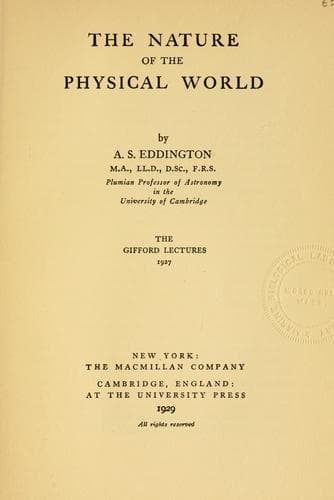
The nature of the physical worldEddington, Arthur Stanley, Sir
Philosophy
The nature of the physical world
Eddington, Arthur Stanley, Sir
Physics -- Philosophy; Science -- Philosophy
As the adjustment between the energy of the orbit jump and the period
of the light carrying away that energy so as to give the constant
quantity is perhaps the most striking evidence of the dominance
of the quantum, it will be worth while to explain how the energy of an
orbit jump in an atom can be measured. It is possible to impart to a
single electron a known amount of energy by making it travel along an
electric field with a measured drop of potential. If this projectile
hits an atom it may cause one of the electrons circulating in the
atom to jump to an upper orbit, but, of course, only if its energy is
sufficient to supply that required for the jump; if the electron has
too little energy it can do nothing and must pass on with its energy
intact. Let us fire a stream of electrons all endowed with the same
known energy into the midst of a group of atoms. If the energy is below
that corresponding to an orbit jump, the stream will pass through
without interference other than ordinary scattering. Now gradually
[Pg 193]
increase the energy of the electrons; quite suddenly we find that the
electrons are leaving a great deal of their energy behind. That means
that the critical energy has been reached and orbit jumps are being
excited. Thus we have a means of measuring the critical energy which
is just that of the jump—the difference of energy of the two states
of the atom. This method of measurement has the advantage that it does
not involve any knowledge of the constant , so that there is no
fear of a vicious circle when we use the measured energies to test the
rule.[32] Incidentally this experiment provides another argument
against the collection-box theory. Small contributions of energy are
not thankfully received, and electrons which offer anything less than
the full contribution for a jump are not allowed to make any payment at
all.
Relation of Classical Laws to Quantum Laws. To follow up the
verification and successful application of the quantum laws would lead
to a detailed survey of the greater part of modern physics—specific
heats, magnetism, X-rays, radioactivity, and so on. We must leave this
and return to a general consideration of the relation between classical
laws and quantum laws. For at least fifteen years we have used
classical laws and quantum laws alongside one another notwithstanding
the irreconcilability of their conceptions. In the model atom the
electrons are supposed to traverse their orbits under the classical
laws of electrodynamics; but they jump from one orbit to another in a
way entirely inconsistent with those laws. The energies of the orbits
[Pg 194]
in hydrogen are calculated by classical laws; but one of the purposes
of the calculation is to verify the association of energy and period in
the unit , which is contrary to classical laws of radiation. The
whole procedure is glaringly contradictory but conspicuously successful.
Public-domain text, read in full here on John Shaqi.
Reviews
Reviews
No reviews yet
Be the first to share your thoughts on this work.
Elsewhere in the archive
Join the Discussion
Join the discussion
Sign in to leave a comment or review.
Sign InorCreate an account