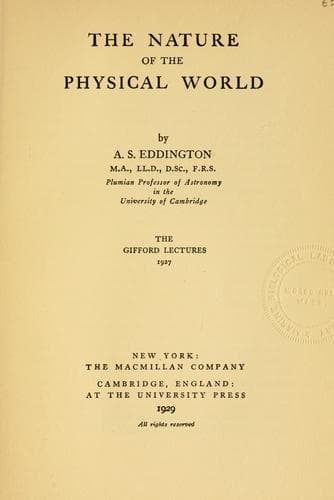
The nature of the physical worldEddington, Arthur Stanley, Sir
Philosophy
The nature of the physical world
Eddington, Arthur Stanley, Sir
Physics -- Philosophy; Science -- Philosophy
There is nothing new under the sun, and this latest volte-face
almost brings us back to Newton’s theory of light—a curious mixture
of corpuscular and wave-theory. There is perhaps a pleasing sentiment
in this “return to Newton”. But to suppose that Newton’s scientific
reputation is especially vindicated by De Broglie’s theory of light, is
as absurd as to suppose that it is shattered by Einstein’s theory of
gravitation. There was no phenomenon known to Newton which could not
[Pg 202]
be amply covered by the wave-theory; and the clearing away of false
evidence for a partly corpuscular theory, which influenced Newton, is
as much a part of scientific progress as the bringing forward of the
(possibly) true evidence, which influences us to-day. To imagine that
Newton’s great scientific reputation is tossing up and down in these
latter-day revolutions is to confuse science with omniscience.
To return to the wavicle.—If that which we have commonly regarded as a
wave partakes also of the nature of a particle, may not that which we
have commonly regarded as a particle partake also of the nature of a
wave? It was not until the present century that experiments were tried
of a kind suitable to bring out the corpuscular aspect of the nature of
light; perhaps experiments may still be possible which will bring out a
wave aspect of the nature of an electron.
So, as a first step, instead of trying to clear up the mystery we
try to extend it. Instead of explaining how anything can possess
simultaneously the incongruous properties of wave and particle we
seek to show experimentally that these properties are universally
associated. There are no pure waves and no pure particles.
The characteristic of a wave-theory is the spreading of a ray of light
after passing through a narrow aperture—a well-known phenomenon
called diffraction. The scale of the phenomenon is proportional to the
wave-length of the light. De Broglie has shown us how to calculate
the lengths of the waves (if any) associated with an electron, i.e.
considering it to be no longer a pure particle but a wavicle. It
appears that in some circumstances the scale of the corresponding
diffraction effects will not be too small for experimental detection.
There are now a number of experimental results quoted as verifying
[Pg 203]
this prediction. I scarcely know whether they are yet to be considered
conclusive, but there does seem to be serious evidence that in
the scattering of electrons by atoms phenomena occur which would
not be produced according to the usual theory that electrons are
purely corpuscular. These effects analogous to the diffraction and
interference of light carry us into the stronghold of the wave-theory.
Long ago such phenomena ruled out all purely corpuscular theories of
light; perhaps to-day we are finding similar phenomena which will rule
out all purely corpuscular theories of matter.[33]
Public-domain text, read in full here on John Shaqi.
Reviews
Reviews
No reviews yet
Be the first to share your thoughts on this work.
Elsewhere in the archive
Join the Discussion
Join the discussion
Sign in to leave a comment or review.
Sign InorCreate an account