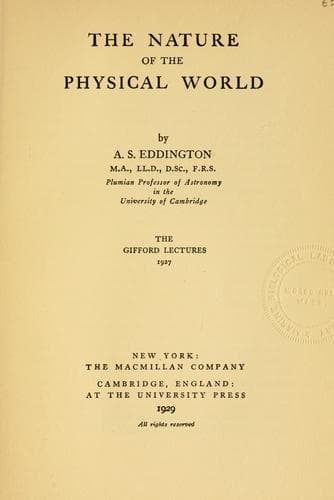
The nature of the physical worldEddington, Arthur Stanley, Sir
Philosophy
The nature of the physical world
Eddington, Arthur Stanley, Sir
Physics -- Philosophy; Science -- Philosophy
In the early days it was often asked, How large is a quantum of light?
One answer is obtained by examining a star image formed with the great
100-inch reflector at Mt. Wilson. The diffraction pattern shows that
each emission from each atom must be filling the whole mirror. For if
one atom illuminates one part only and another atom another part only,
we ought to get the same effect by illuminating different parts of
the mirror by different stars (since there is no particular virtue in
using atoms from the same star); actually the diffraction pattern then
obtained is not the same. The quantum must be large enough to cover
a 100-inch mirror.
But if this same star-light without any artificial concentration falls
on a film of potassium, electrons will fly out each with the whole
energy of a quantum. This is not a trigger action releasing energy
already stored in the atom, because the amount of energy is fixed by
the nature of the light, not by the nature of the atom. A whole quantum
of light energy must have gone into the atom and blasted away the
electron. The quantum must be small enough to enter an atom.
I do not think there is much doubt as to the ultimate origin of this
contradiction. We must not think about space and time in connection
with an individual quantum; and the extension of a quantum in space
[Pg 201]
has no real meaning. To apply these conceptions to a single quantum
is like reading the Riot Act to one man. A single quantum has not
travelled 50 billion miles from Sirius; it has not been 8 years on the
way. But when enough quanta are gathered to form a quorum there will be
found among them statistical properties which are the genesis of
the 50 billion miles’ distance of Sirius and the 8 years’ journey of
the light.
Wave-Theory of Matter. It is comparatively easy to realise what
we have got to do. It is much more difficult to start to do it. Before
we review the attempts in the last year or two to grapple with this
problem we shall briefly consider a less drastic method of progress
initiated by De Broglie. For the moment we shall be content to accept
the mystery as a mystery. Light, we will say, is an entity with the
wave property of spreading out to fill the largest object glass and
with all the well-known properties of diffraction and interference;
simultaneously it is an entity with the corpuscular or bullet property
of expending its whole energy on one very small target. We can scarcely
describe such an entity as a wave or as a particle; perhaps as a
compromise we had better call it a “wavicle”.
Public-domain text, read in full here on John Shaqi.
Reviews
Reviews
No reviews yet
Be the first to share your thoughts on this work.
Elsewhere in the archive
Join the Discussion
Join the discussion
Sign in to leave a comment or review.
Sign InorCreate an account