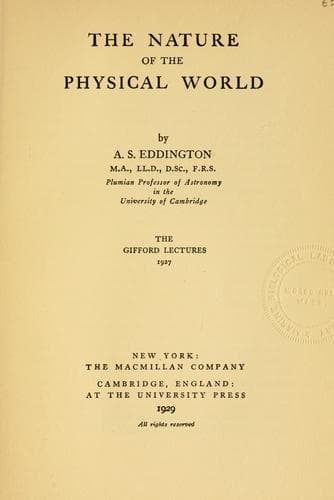
The nature of the physical worldEddington, Arthur Stanley, Sir
Philosophy
The nature of the physical world
Eddington, Arthur Stanley, Sir
Physics -- Philosophy; Science -- Philosophy
On the right-hand side, besides (the atom of action) and the
merely numerical factor , there appears (the square root
of -1) which may seem rather mystical. But this is only a well-known
subterfuge; and far back in the last century physicists and engineers
were well aware that in their formulae was a kind of
signal to look out for waves or oscillations. The right-hand side
contains nothing unusual, but the left-hand side baffles imagination.
We call and co-ordinates and momenta, borrowing our
vocabulary from the world of space and time and other coarse-grained
experience; but that gives no real light on their nature, nor does it
explain why is so ill-behaved as to be unequal to .
It is here that the three theories differ most essentially. Obviously
and cannot represent simple numerical measures, for then
would be zero. For Schrödinger is an operator.
His “momentum” is not a quantity but a signal to us to perform a
certain mathematical operation on any quantities which may follow. For
Born and Jordan is a matrix—not one quantity, nor several
quantities, but an infinite number of quantities arranged in systematic
array. For Dirac is a symbol without any kind of numerical
interpretation; he calls it a -number, which is a way of saying
that it is not a number at all.
I venture to think that there is an idea implied in Dirac’s treatment
[Pg 209]
which may have great philosophical significance, independently of any
question of success in this particular application. The idea is that in
digging deeper and deeper into that which lies at the base of physical
phenomena we must be prepared to come to entities which, like many
things in our conscious experience, are not measurable by numbers in
any way; and further it suggests how exact science, that is to say the
science of phenomena correlated to measure-numbers, can be founded on
such a basis.
One of the greatest changes in physics between the nineteenth century
and the present day has been the change in our ideal of scientific
explanation. It was the boast of the Victorian physicist that he
would not claim to understand a thing until he could make a model of
it; and by a model he meant something constructed of levers, geared
wheels, squirts, or other appliances familiar to an engineer. Nature
in building the universe was supposed to be dependent on just the same
kind of resources as any human mechanic; and when the physicist sought
an explanation of phenomena his ear was straining to catch the hum of
machinery. The man who could make gravitation out of cog-wheels would
have been a hero in the Victorian age.
Public-domain text, read in full here on John Shaqi.
Reviews
Reviews
No reviews yet
Be the first to share your thoughts on this work.
Elsewhere in the archive
Join the Discussion
Join the discussion
Sign in to leave a comment or review.
Sign InorCreate an account