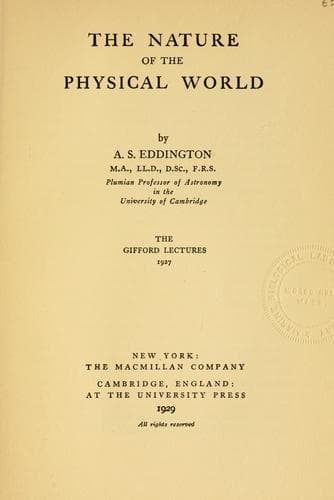
The nature of the physical worldEddington, Arthur Stanley, Sir
Philosophy
The nature of the physical world
Eddington, Arthur Stanley, Sir
Physics -- Philosophy; Science -- Philosophy
Nowadays we do not encourage the engineer to build the world for us
out of his material, but we turn to the mathematician to build it
out of his material. Doubtless the mathematician is a loftier being
than the engineer, but perhaps even he ought not to be entrusted
with the Creation unreservedly. We are dealing in physics with a
symbolic world, and we can scarcely avoid employing the mathematician
who is the professional wielder of symbols; but he must rise to the
full opportunities of the responsible task entrusted to him and not
indulge too freely his own bias for symbols with an arithmetical
[Pg 210]
interpretation. If we are to discern controlling laws of Nature not
dictated by the mind it would seem necessary to escape as far as
possible from the cut-and-dried framework into which the mind is so
ready to force everything that it experiences.
I think that in principle Dirac’s method asserts this kind of
emancipation. He starts with basal entities inexpressible by numbers
or number-systems and his basal laws are symbolic expressions
unconnected with arithmetical operations. The fascinating point is
that as the development proceeds actual numbers are exuded
from the symbols. Thus although and individually have
no arithmetical interpretation, the combination has the
arithmetical interpretation expressed by the formula above quoted. By
furnishing numbers, though itself non-numerical, such a theory can well
be the basis for the measure-numbers studied in exact science. The
measure-numbers, which are all that we glean from a physical survey
of the world, cannot be the whole world; they may not even be so much
of it as to constitute a self-governing unit. This seems the natural
interpretation of Dirac’s procedure in seeking the governing laws of
exact science in a non-arithmetical calculus.
I am afraid it is a long shot to predict anything like this emerging
from Dirac’s beginning; and for the moment Schrödinger has rent much
of the mystery from the ’s and ’s by showing that a less
transcendental interpretation is adequate for present applications. But
I like to think that we may have not yet heard the last of the idea.
Public-domain text, read in full here on John Shaqi.
Reviews
Reviews
No reviews yet
Be the first to share your thoughts on this work.
Elsewhere in the archive
Join the Discussion
Join the discussion
Sign in to leave a comment or review.
Sign InorCreate an account