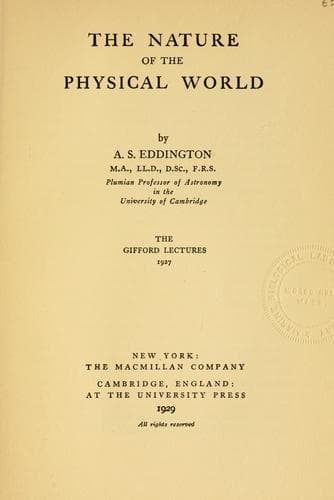
The nature of the physical worldEddington, Arthur Stanley, Sir
Philosophy
The nature of the physical world
Eddington, Arthur Stanley, Sir
Physics -- Philosophy; Science -- Philosophy
Generally the oscillations in the sub-aether are too rapid for us
to detect directly; their frequency reaches the plane of ordinary
experience by affecting the speed of propagation, because the speed
depends (as already stated) on the wave-length or frequency. Calling
the frequency , the equation expressing the law of propagation
of the ripples will contain a term in . There will be another
term expressing the modification caused by the “field of force”
emanating from the bodies present in the neighbourhood. This can be
treated as a kind of spurious , since it emerges into our gross
experience by the same method that does. If produces
those phenomena which make us recognise it as energy, the spurious
will produce similar phenomena corresponding to a spurious kind
of energy. Clearly the latter will be what we call potential energy,
[Pg 213]
since it originates from influences attributable to the presence of
surrounding objects.
Assuming that we know both the real and the spurious or
potential for our ripples, the equation of wave-propagation
is settled, and we can proceed to solve any problem concerning
wave-propagation. In particular we can solve the problem as to how the
stormy areas move about. This gives a remarkable result which provides
the first check on our theory. The stormy areas (if small enough) move
under precisely the same laws that govern the motions of particles in
classical mechanics. The equations for the motion of a wave-group
with given frequency and potential frequency are the same as the
classical equations of motion of a particle with the corresponding
energy and potential energy.
It has to be noticed that the velocity of a stormy area or group of
waves is not the same as the velocity of an individual wave. This is
well known in the study of water-waves as the distinction between
group-velocity and wave-velocity. It is the group-velocity that is
observed by us as the motion of the material particle.
We should have gained very little if our theory did no more than
re-establish the results of classical mechanics on this rather
fantastic basis. Its distinctive merits begin to be apparent when
we deal with phenomena not covered by classical mechanics. We have
considered a stormy area of so small extent that its position is as
definite as that of a classical particle, but we may also consider an
area of wider extent. No precise delimitation can be drawn between a
large area and a small area, so that we shall continue to associate
the idea of a particle with it; but whereas a small concentrated storm
fixes the position of the particle closely, a more extended storm
[Pg 214]
leaves it very vague. If we try to interpret an extended wave-group in
classical language we say that it is a particle which is not at any
definite point of space, but is loosely associated with a wide region.
Public-domain text, read in full here on John Shaqi.
Reviews
Reviews
No reviews yet
Be the first to share your thoughts on this work.
Elsewhere in the archive
Join the Discussion
Join the discussion
Sign in to leave a comment or review.
Sign InorCreate an account