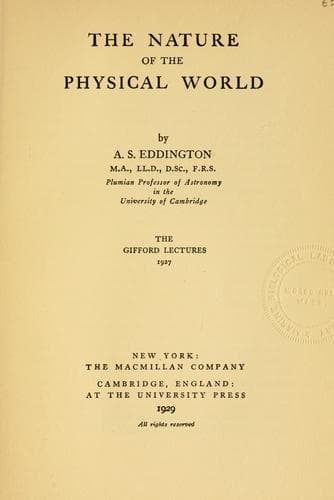
The nature of the physical worldEddington, Arthur Stanley, Sir
Philosophy
The nature of the physical world
Eddington, Arthur Stanley, Sir
Physics -- Philosophy; Science -- Philosophy
A general kind of reason for this can be seen without much difficulty.
Suppose it is a question of knowing the position and momentum of an
electron. So long as the electron is not interacting with the rest
of the universe we cannot be aware of it. We must take our chance
of obtaining knowledge of it at moments when it is interacting with
something and thereby producing effects that can be observed. But in
any such interaction a complete quantum is involved; and the passage
of this quantum, altering to an important extent the conditions at the
moment of our observation, makes the information out of date even as we
obtain it.
Suppose that (ideally) an electron is observed under a powerful
microscope in order to determine its position with great accuracy. For
it to be seen at all it must be illuminated and scatter light to reach
the eye. The least it can scatter is one quantum. In scattering this
it receives from the light a kick of unpredictable amount; we can only
state the respective probabilities of kicks of different amounts. Thus
the condition of our ascertaining the position is that we disturb the
electron in an incalculable way which will prevent our subsequently
ascertaining how much momentum it had. However, we shall be able to
ascertain the momentum with an uncertainty represented by the kick,
and if the probable kick is small the probable error will be small. To
keep the kick small we must use a quantum of small energy, that is to
say, light of long wave-length. But to use long wave-length reduces
the accuracy of our microscope. The longer the waves, the larger the
diffraction images. And it must be remembered that it takes a great
many quanta to outline the diffraction image; our one scattered
[Pg 224]
quantum can only stimulate one atom in the retina of the eye, at some
haphazard point within the theoretical diffraction image. Thus there
will be an uncertainty in our determination of position of the electron
proportional to the size of the diffraction image. We are in a dilemma.
We can improve the determination of the position with the microscope
by using light of shorter wave-length, but that gives the electron a
greater kick and spoils the subsequent determination of momentum.
Public-domain text, read in full here on John Shaqi.
Reviews
Reviews
No reviews yet
Be the first to share your thoughts on this work.
Elsewhere in the archive
Join the Discussion
Join the discussion
Sign in to leave a comment or review.
Sign InorCreate an account