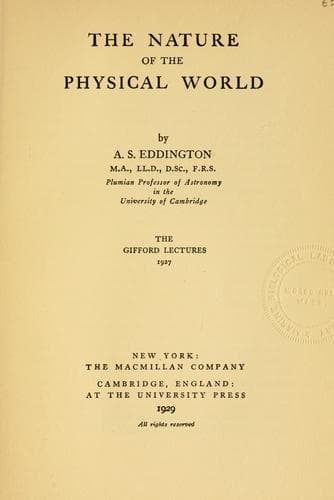
The nature of the physical worldEddington, Arthur Stanley, Sir
Philosophy
The nature of the physical world
Eddington, Arthur Stanley, Sir
Physics -- Philosophy; Science -- Philosophy
When the concealment is found to be perfectly systematic, then we
must banish the corresponding entity from the physical world. There
is really no option. The link with our consciousness is completely
broken. When we cannot point to any causal effect on anything that
comes into our experience, the entity merely becomes part of the
unknown—undifferentiated from the rest of the vast unknown. From
time to time physical discoveries are made; and new entities, coming
out of the unknown, become connected to our experience and are duly
[Pg 222]
named. But to leave a lot of unattached labels floating in the as yet
undifferentiated unknown in the hope that they may come in useful
later on, is no particular sign of prescience and is not helpful to
science. From this point of view we assert that the description of the
position and velocity of an electron beyond a limited number of places
of decimals is an attempt to describe something that does not exist;
although curiously enough the description of position or of velocity if
it had stood alone might have been allowable.
Ever since Einstein’s theory showed the importance of securing that
the physical quantities which we talk about are actually connected
to our experience, we have been on our guard to some extent against
meaningless terms. Thus distance is defined by certain operations of
measurement and not with reference to nonsensical conceptions such as
the “amount of emptiness” between two points. The minute distances
referred to in atomic physics naturally aroused some suspicion, since
it is not always easy to say how the postulated measurements could
be imagined to be carried out. I would not like to assert that this
point has been cleared up; but at any rate it did not seem possible
to make a clean sweep of all minute distances, because cases could
be cited in which there seemed no natural limit to the accuracy of
determination of position. Similarly there are ways of determining
momentum apparently unlimited in accuracy. What escaped notice was
that the two measurements interfere with one another in a systematic
way, so that the combination of position with momentum, legitimate on
the large scale, becomes indefinable on the small scale. The principle
of indeterminacy is scientifically stated as follows: if is
a co-ordinate and the corresponding momentum, the necessary
[Pg 223]
uncertainty of our knowledge of multiplied by the uncertainty of
is of the order of magnitude of the quantum constant .
Public-domain text, read in full here on John Shaqi.
Reviews
Reviews
No reviews yet
Be the first to share your thoughts on this work.
Elsewhere in the archive
Join the Discussion
Join the discussion
Sign in to leave a comment or review.
Sign InorCreate an account