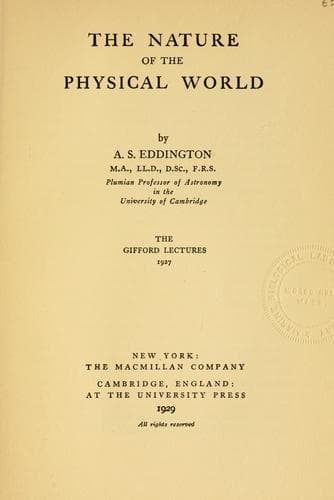
The nature of the physical worldEddington, Arthur Stanley, Sir
Philosophy
The nature of the physical world
Eddington, Arthur Stanley, Sir
Physics -- Philosophy; Science -- Philosophy
A New Epistemology. The principle of indeterminacy is
epistemological. It reminds us once again that the world of physics
is a world contemplated from within surveyed by appliances which are
part of it and subject to its laws. What the world might be deemed like
if probed in some supernatural manner by appliances not furnished by
itself we do not profess to know.
[Pg 226]
There is a doctrine well known to philosophers that the moon ceases to
exist when no one is looking at it. I will not discuss the doctrine
since I have not the least idea what is the meaning of the word
existence when used in this connection. At any rate the science of
astronomy has not been based on this spasmodic kind of moon. In the
scientific world (which has to fulfil functions less vague than merely
existing) there is a moon which appeared on the scene before the
astronomer; it reflects sunlight when no one sees it; it has mass when
no one is measuring the mass; it is distant 240,000 miles from the
earth when no one is surveying the distance; and it will eclipse the
sun in 1999 even if the human race has succeeding in killing itself off
before that date. The moon—the scientific moon—has to play the part
of a continuous causal element in a world conceived to be all causally
interlocked.
What should we regard as a complete description of this
scientific world? We must not introduce anything like velocity through
aether, which is meaningless since it is not assigned any causal
connection with our experience. On the other hand we cannot limit the
description to the immediate data of our own spasmodic observations.
The description should include nothing that is unobservable but a
great deal that is actually unobserved. Virtually we postulate an
infinite army of watchers and measurers. From moment to moment they
survey everything that can be surveyed and measure everything that can
be measured by methods which we ourselves might conceivably employ.
Everything they measure goes down as part of the complete description
of the scientific world. We can, of course, introduce derivative
descriptions, words expressing mathematical combinations of the
immediate measures which may give greater point to the description—so
[Pg 227]
that we may not miss seeing the wood for the trees.
Public-domain text, read in full here on John Shaqi.
Reviews
Reviews
No reviews yet
Be the first to share your thoughts on this work.
Elsewhere in the archive
Join the Discussion
Join the discussion
Sign in to leave a comment or review.
Sign InorCreate an account