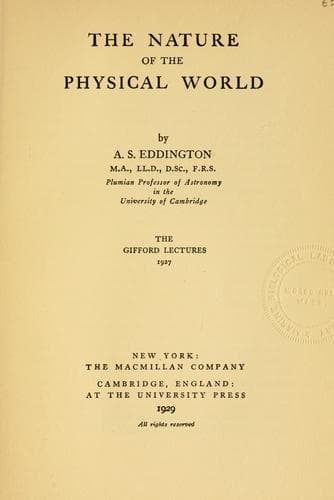
The nature of the physical worldEddington, Arthur Stanley, Sir
Philosophy
The nature of the physical world
Eddington, Arthur Stanley, Sir
Physics -- Philosophy; Science -- Philosophy
By employing the known physical laws expressing the uniformities of
Nature we can to a large extent dispense with this army of watchers. We
can afford to let the moon out of sight for an hour or two and deduce
where it has been in the meantime. But when I assert that the moon
(which I last saw in the west an hour ago) is now setting, I assert
this not as my deduction but as a true fact of the scientific world. I
am still postulating the imaginary watcher; I do not consult him, but I
retain him to corroborate my statement if it is challenged. Similarly,
when we say that the distance of Sirius is 50 billion miles we are not
giving a merely conventional interpretation to its measured parallax;
we intend to give it the same status in knowledge as if someone had
actually gone through the operation of laying measuring rods end to
end and counted how many were needed to reach to Sirius; and we should
listen patiently to anyone who produced reasons for thinking that our
deductions did not correspond to the “real facts”, i.e. the facts as
known to our army of measurers. If we happen to make a deduction which
could not conceivably be corroborated or disproved by these diligent
measurers, there is no criterion of its truth or falsehood and it is
thereby a meaningless deduction.
This theory of knowledge is primarily intended to apply to our
macroscopic or large-scale survey of the physical world, but it has
usually been taken for granted that it is equally applicable to a
microscopic study. We have at last realised the disconcerting fact that
though it applies to the moon it does not apply to the electron.
It does not hurt the moon to look at it. There is no inconsistency in
[Pg 228]
supposing it to have been under the surveillance of relays of watchers
whilst we were asleep. But it is otherwise with an electron. At certain
times, viz. when it is interacting with a quantum, it might be detected
by one of our watchers; but between whiles it virtually disappears
from the physical world, having no interaction with it. We might arm
our observers with flash-lamps to keep a more continuous watch on
its doings; but the trouble is that under the flashlight it will not
go on doing what it was doing in the dark. There is a fundamental
inconsistency in conceiving the microscopic structure of the physical
world to be under continuous survey because the surveillance would
itself wreck the whole machine.
I expect that at first this will sound to you like a merely dialectical
difficulty. But there is much more in it than that. The deliberate
frustration of our efforts to bring knowledge of the microscopic world
into orderly plan, is a strong hint to alter the plan.
Public-domain text, read in full here on John Shaqi.
Reviews
Reviews
No reviews yet
Be the first to share your thoughts on this work.
Elsewhere in the archive
Join the Discussion
Join the discussion
Sign in to leave a comment or review.
Sign InorCreate an account