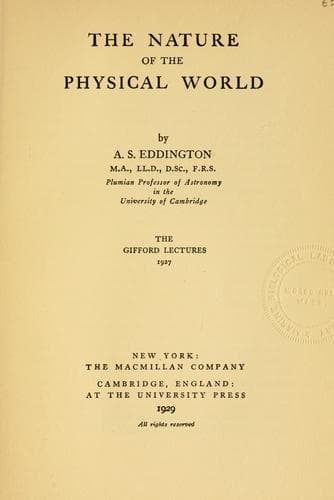
The nature of the physical worldEddington, Arthur Stanley, Sir
Philosophy
The nature of the physical world
Eddington, Arthur Stanley, Sir
Physics -- Philosophy; Science -- Philosophy
This completes the first part of our task to introduce numerical
measure of structure into the basal material. The method is not so
artificial as it appears at first sight. Unless we shirk the problem
by putting the desired physical properties of the world directly
into the original relations and relata, we must derive them from the
structural interlocking of the relations; and such interlocking is
naturally traced by following circuits among the relations. The axiom
of comparability of contiguous relations only discriminates between
like and unlike, and does not initially afford any means of classifying
various degrees and kinds of unlikeness; but we have found a means of
[Pg 235]
specifying the kind of unlikeness of and by reference to
a circuit which “transforms” one into the other. Thus we have built a
quantitative study of diversity on a definition of similarity.
The numerical measures of structure will be dependent on, and
vary according to, the arbitrary code of monomarks used for the
identification of relata. This, however, renders them especially
suitable for building the ordinary quantities of physics. When the
monomarks become co-ordinates of space and time the arbitrary choice of
the code will be equivalent to the arbitrary choice of a frame of space
and time; and it is in accordance with the theory of relativity that
the measures of structure and the physical quantities to be built from
them should vary with the frame of space and time. Physical quantities
in general have no absolute value, but values relative to chosen frames
of reference or codes of monomarks.
We have now fashioned our bricks from the primitive clay and the next
job is to build with them. The 256 measures of structure varying
from point to point of the world are somewhat reduced in number when
duplicates are omitted; but even so they include a great deal of
useless lumber which we do not require for the building. That seems
to have worried a number of the most eminent physicists; but I do
not quite see why. Ultimately it is the mind that decides what is
lumber—which part of our building will shadow the things of common
experience, and which has no such counterpart. It is no part of our
function as purveyors of building material to anticipate what will be
chosen for the palace of the mind. The lumber will now be dropped as
irrelevant in the further operations, but I do not agree with those
[Pg 236]
who think it a blemish on the theory that the lumber should ever have
appeared in it.
By adding together certain of the measures of structure in a
symmetrical manner and by ignoring others we reduce the really
important measures to 16.[37] These can be divided into 10 forming a
symmetrical scheme and 6 forming an antisymmetrical scheme. This is the
great point of bifurcation of the world.
Public-domain text, read in full here on John Shaqi.
Reviews
Reviews
No reviews yet
Be the first to share your thoughts on this work.
Elsewhere in the archive
Join the Discussion
Join the discussion
Sign in to leave a comment or review.
Sign InorCreate an account