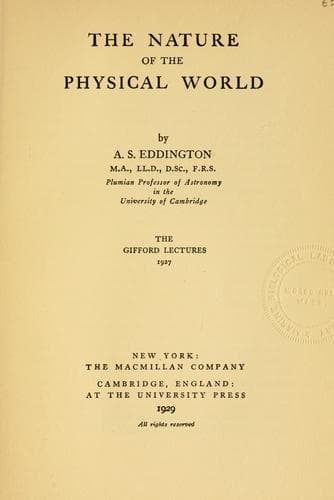
The nature of the physical worldEddington, Arthur Stanley, Sir
Philosophy
The nature of the physical world
Eddington, Arthur Stanley, Sir
Physics -- Philosophy; Science -- Philosophy
Symmetrical coefficients (10). Out of these we find it possible
to construct Geometry and Mechanics. They are the ten potentials of
Einstein (). We derive from them space, time, and the
world-curvatures representing the mechanical properties of matter, viz.
momentum, energy, stress, etc.
Antisymmetrical coefficients (6). Out of these we construct
Electromagnetism. They are the three components of electric intensity
and three components of magnetic force. We derive electric and magnetic
potential, electric charge and current, light and other electric waves.
We do not derive the laws and phenomena of atomicity. Our building
operation has somehow been too coarse to furnish the microscopic
structure of the world, so that atoms, electrons and quanta are at
present beyond our skill.
But in regard to what is called field-physics the construction
is reasonably complete. The metrical, gravitational and electromagnetic
fields are all included. We build the quantities enumerated above;
and they obey the great laws of field-physics in virtue of the way
in which they have been built. That is the special feature; the
field laws—conservation of energy, mass, momentum and of electric
[Pg 237]
charge, the law of gravitation, Maxwell’s equations—are not controlling
laws.[38] They are truisms. Not truisms when approached in the way the
mind looks out on the world, but truisms when we encounter them in a
building up of the world from a basal structure. I must try to make
clear our new attitude to these laws.
Identical Laws. Energy momentum and stress, which we have
identified with the ten principal curvatures of the world, are the
subject of the famous laws of conservation of energy and momentum.
Granting that the identification is correct, these laws are
mathematical identities. Violation of them is unthinkable. Perhaps
I can best indicate their nature by an analogy.
Public-domain text, read in full here on John Shaqi.
Reviews
Reviews
No reviews yet
Be the first to share your thoughts on this work.
Elsewhere in the archive
Join the Discussion
Join the discussion
Sign in to leave a comment or review.
Sign InorCreate an account