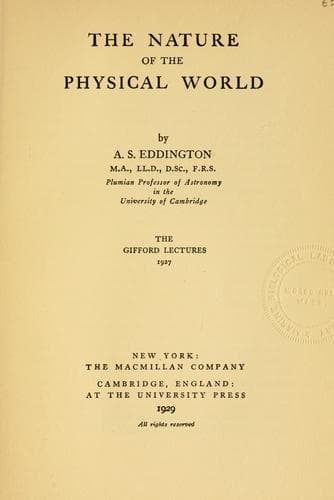
The nature of the physical worldEddington, Arthur Stanley, Sir
Philosophy
The nature of the physical world
Eddington, Arthur Stanley, Sir
Physics -- Philosophy; Science -- Philosophy
The law of conservation of momentum and energy results from the
overlapping of the different aspects in which the “non-emptiness of
space” presents itself to our practical experience. Once again we find
that a fundamental law of physics is no controlling law but a “put-up
job” as soon as we have ascertained the nature of that which is
[Pg 239]
obeying it. We can measure certain forms of energy with a thermometer,
momentum with a ballistic pendulum, stress with a manometer. Commonly
we picture these as separate physical entities whose behaviour towards
each other is controlled by a law. But now the theory is that the three
instruments measure different but slightly overlapping aspects of a
single physical condition, and a law connecting their measurements is
of the same tautological type as a “law” connecting measurements with a
metre-rule and a foot-rule.
I have said that violation of these laws of conservation is
unthinkable. Have we then found physical laws which will endure for
all time unshaken by any future revolution? But the proviso must
be remembered, “granting that the identification [of their subject
matter] is correct”. The law itself will endure as long as two and
two make four; but its practical importance depends on our knowing
that which obeys it. We think we have this knowledge, but do not claim
infallibility in this respect. From a practical point of view the law
would be upset, if it turned out that the thing conserved was not that
which we are accustomed to measure with the above-mentioned instruments
but something slightly different.
Selective Influence of the Mind. This brings us very near to the
problem of bridging the gulf between the scientific world and the world
of everyday experience. The simpler elements of the scientific world
have no immediate counterparts in everyday experience; we use them to
build things which have counterparts. Energy, momentum and stress in
the scientific world shadow well-known features of the familiar world.
[Pg 240]
I feel stress in my muscles; one form of energy gives me the
sensation of warmth; the ratio of momentum to mass is velocity, which
generally enters into my experience as change of position of objects.
When I say that I feel these things I must not forget that the feeling,
in so far as it is located in the physical world at all, is not in the
things themselves but in a certain corner of my brain. In fact, the
mind has also invented a craft of world-building; its familiar world
is built not from the distribution of relata and relations but by its
own peculiar interpretation of the code messages transmitted along the
nerves into its sanctum.
Public-domain text, read in full here on John Shaqi.
Reviews
Reviews
No reviews yet
Be the first to share your thoughts on this work.
Elsewhere in the archive
Join the Discussion
Join the discussion
Sign in to leave a comment or review.
Sign InorCreate an account