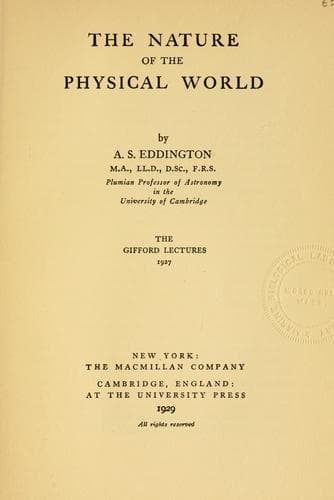
The nature of the physical worldEddington, Arthur Stanley, Sir
Philosophy
The nature of the physical world
Eddington, Arthur Stanley, Sir
Physics -- Philosophy; Science -- Philosophy
Accordingly we must not lose sight of the fact that the world which
physics attempts to describe arises from the convergence of two
schemes of world-building. If we look at it only from the physical
side there is inevitably an arbitrariness about the building. Given
the bricks—the 16 measures of world-structure—there are all sorts of
things we might build. Or we might take up again some of the rejected
lumber and build a still wider variety of things. But we do not build
arbitrarily; we build to order. The things we build have certain
remarkable properties; they have these properties in virtue of the
way they are built, but they also have them because such properties
were ordered. There is a general description which covers at
any rate most of the building operations needed in the construction of
the physical world; in mathematical language the operation consists in
Hamiltonian differentiation of an invariant function of the 16 measures
of structure. I do not think that there is anything in the basal
relation-structure that cries out for this special kind of combination;
the significance of this process is not in inorganic nature. Its
significance is that it corresponds to an outlook adopted by the mind
[Pg 241]
for its own reasons; and any other building process would not converge
to the mental scheme of world-building. The Hamiltonian derivative
has just that kind of quality which makes it stand out in our minds
as an active agent against a passive extension of space and time; and
Hamiltonian differentiation is virtually the symbol for creation of
an active world out of the formless background. Not once in the dim
past, but continuously by conscious mind is the miracle of the Creation
wrought.
By following this particular plan of building we construct things
which satisfy the law of conservation, that is to say things which are
permanent. The law of conservation is a truism for the things which
satisfy it; but its prominence in the scheme of law of the physical
world is due to the mind having demanded permanence. We might have
built things which do not satisfy this law. In fact we do build one
very important thing “action” which is not permanent; in respect to
“action” physics has taken the bit in her teeth, and has insisted on
recognising this as the most fundamental thing of all, although the
mind has not thought it worthy of a place in the familiar world and has
not vivified it by any mental image or conception. You will understand
that the building to which I refer is not a shifting about of material;
it is like building constellations out of stars. The things which we
might have built but did not, are there just as much as those we did
build. What we have called building is rather a selection from the
patterns that weave themselves.
Public-domain text, read in full here on John Shaqi.
Reviews
Reviews
No reviews yet
Be the first to share your thoughts on this work.
Elsewhere in the archive
Join the Discussion
Join the discussion
Sign in to leave a comment or review.
Sign InorCreate an account