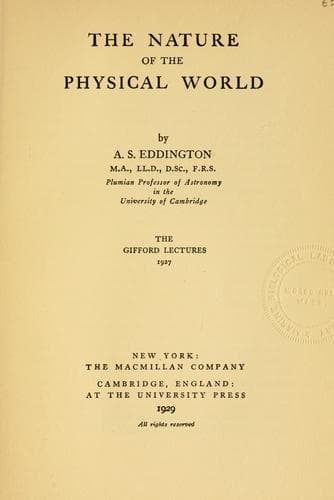
The nature of the physical worldEddington, Arthur Stanley, Sir
Philosophy
The nature of the physical world
Eddington, Arthur Stanley, Sir
Physics -- Philosophy; Science -- Philosophy
Familiar Conceptions and Scientific Symbols. We have said
in the Introduction that the raw material of the scientific world
is not borrowed from the familiar world. It is only recently that
the physicist has deliberately cut himself adrift from familiar
conceptions. He did not set out to discover a new world but to tinker
with the old. Like everyone else he started with the idea that things
are more or less what they seem, and that our vivid impression of our
environment may be taken as a basis to work from. Gradually it has
been found that some of its most obvious features must be rejected.
We learn that instead of standing on a firm immovable earth proudly
rearing our heads towards the vault of heaven, we are hanging by our
feet from a globe careering through space at a great many miles a
second. But this new knowledge can still be grasped by a rearrangement
of familiar conceptions. I can picture to myself quite vividly the
state of affairs just described; if there is any strain, it is on my
credulity, not on my powers of conception. Other advances of knowledge
can be accommodated by that very useful aid to comprehension—“like
this only more so”. For example, if you think of something like a speck
of dust only more so you have the atom as it was conceived up to
a fairly recent date.
In addition to the familiar entities the physicist had to reckon with
mysterious agencies such as gravitation or electric force; but this
did not disturb his general outlook. We cannot say what electricity
is “like”; but at first its aloofness was not accepted as final. It
[Pg 248]
was taken to be one of the main aims of research to discover how to
reduce these agencies to something describable in terms of familiar
conceptions—in short to “explain” them. For example, the true nature
of electric force might be some kind of displacement of the aether.
(Aether was at that time a familiar conception—like some extreme kind
of matter only more so.) Thus there grew up a waiting-list
of entities which should one day take on their rightful relation to
conceptions of the familiar world. Meanwhile physics had to treat them
as best it could without knowledge of their nature.
Public-domain text, read in full here on John Shaqi.
Reviews
Reviews
No reviews yet
Be the first to share your thoughts on this work.
Elsewhere in the archive
Join the Discussion
Join the discussion
Sign in to leave a comment or review.
Sign InorCreate an account