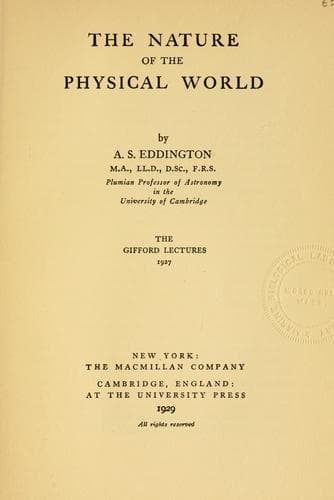
The nature of the physical worldEddington, Arthur Stanley, Sir
Philosophy
The nature of the physical world
Eddington, Arthur Stanley, Sir
Physics -- Philosophy; Science -- Philosophy
If there are any genuine laws of control of the physical world they
must be sought in the third group—the transcendental laws. The
transcendental laws comprise all those which have not become obvious
identities implied in the scheme of world-building. They are concerned
with the particular behaviour of atoms, electrons and quanta—that is
to say, the laws of atomicity of matter, electricity and action. We
seem to be making some progress towards formulating them, but it is
clear that the mind is having a much harder struggle to gain a rational
conception of them than it had with the classical field-laws. We have
seen that the field-laws, especially the laws of conservation, are
indirectly imposed by the mind which has, so to speak, commanded a plan
of world-building to satisfy them. It is a natural suggestion that the
greater difficulty in elucidating the transcendental laws is due to
the fact that we are no longer engaged in recovering from Nature what
we have ourselves put into Nature, but are at last confronted with its
own intrinsic system of government. But I scarcely know what to think.
We must not assume that the possible developments of the new attitude
towards natural law have been exhausted in a few short years. It may
be that the laws of atomicity, like the laws of conservation, arise
only in the presentation of the world to us and can be recognised as
identities by some extension of the argument we have followed. But it
is perhaps as likely that after we have cleared away all the superadded
laws which arise solely in our mode of apprehension of the world about
us, there will be left an external world developing under genuine laws
of control.
At present we can notice the contrast that the laws which we now
[Pg 246]
recognise as man-made are characterised by continuity, whereas the laws
to which the mind as yet lays no claim are characterised by atomicity.
The quantum theory with its avoidance of fractions and insistence on
integral units seems foreign to any scheme which we should be likely
subconsciously to have imposed as a frame for natural phenomena.
Perhaps our final conclusion as to the world of physics will resemble
Kronecker’s view of pure mathematics.
“God made the integers, all else is the work of man.”[40]
[37]
Mathematically we contract the original tensor of the
fourth rank to one of the second rank.
[38]
One law commonly grouped with these, viz. the law of
ponderomotive force of the electric field, is not included. It seems
to be impossible to get at the origin of this law without tackling
electron structure which is beyond the scope of our present exercise in
world-building.
[39]
This was not intended to allude to certain consequential
effects of the waves; it is true, I think, of the happier impressions
of the voyage.
[40]
Die ganzen Zahlen hat Gott gemacht; alles anderes ist
Menschenwerk.
[Pg 247]
Chapter XII
POINTER READINGS
Public-domain text, read in full here on John Shaqi.
Reviews
Reviews
No reviews yet
Be the first to share your thoughts on this work.
Elsewhere in the archive
Join the Discussion
Join the discussion
Sign in to leave a comment or review.
Sign InorCreate an account