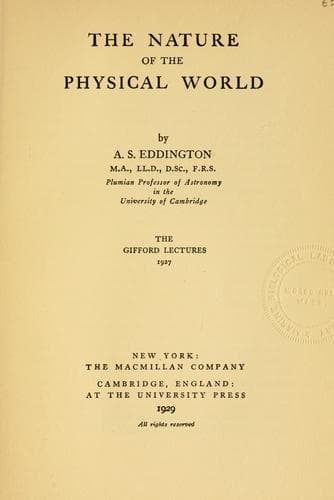
The nature of the physical worldEddington, Arthur Stanley, Sir
Philosophy
The nature of the physical world
Eddington, Arthur Stanley, Sir
Physics -- Philosophy; Science -- Philosophy
The synthetic method by which we build up from its own symbolic
elements a world which will imitate the actual behaviour of the world
of familiar experience is adopted almost universally in scientific
theories. Any ordinary theoretical paper in the scientific journals
tacitly assumes that this approach is adopted. It has proved to be the
most successful procedure; and it is the actual procedure underlying
the advances set forth in the scientific part of this book. But I would
not claim that no other way of working is admissible. We agree that
at the end of the synthesis there must be a linkage to the familiar
world of consciousness, and we are not necessarily opposed to attempts
to reach the physical world from that end. From the point of view of
philosophy it is desirable that this entrance should be explored, and
it is conceivable that it may be fruitful scientifically. If I have
rightly understood Dr. Whitehead’s philosophy, that is the course
which he takes. It involves a certain amount of working backwards
(as we should ordinarily describe it); but his method of “extensive
abstraction” is intended to overcome some of the difficulties of such a
procedure. I am not qualified to form a critical judgment of this work,
but in principle it appears highly interesting. Although this book may
in most respects seem diametrically opposed to Dr. Whitehead’s widely
read philosophy of Nature, I think it would be truer to regard him as
an ally who from the opposite side of the mountain is tunnelling to
[Pg 250]
meet his less philosophically minded colleagues. The important thing is
not to confuse the two entrances.
Nature of Exact Science. One of the characteristics of physics
is that it is an exact science, and I have generally identified the
domain of physics with the domain of exact science. Strictly speaking
the two are not synonymous. We can imagine a science arising which
has no contact with the usual phenomena and laws of physics, which
yet admits of the same kind of exact treatment. It is conceivable
that the Mendelian theory of heredity may grow into an independent
science of this kind, for it would seem to occupy in biology the same
position that the atomic theory occupied in chemistry a hundred years
ago. The trend of the theory is to analyse complex individuals into
“unit characters”. These are like indivisible atoms with affinities
and repulsions; their matings are governed by the same laws of chance
which play so large a part in chemical thermodynamics; and numerical
statistics of the characters of a population are predictable in the
same way as the results of a chemical reaction.
Public-domain text, read in full here on John Shaqi.
Reviews
Reviews
No reviews yet
Be the first to share your thoughts on this work.
Elsewhere in the archive
Join the Discussion
Join the discussion
Sign in to leave a comment or review.
Sign InorCreate an account