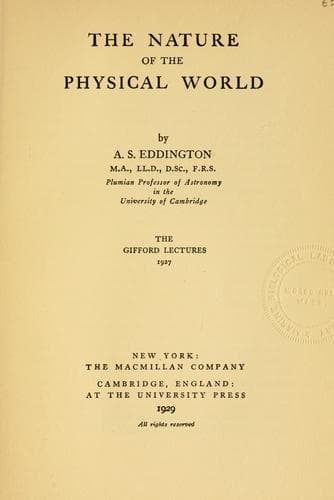
The nature of the physical worldEddington, Arthur Stanley, Sir
Philosophy
The nature of the physical world
Eddington, Arthur Stanley, Sir
Physics -- Philosophy; Science -- Philosophy
Now the effect of such a theory on our philosophical views of the
significance of life does not depend on whether the Mendelian atom
admits of a strictly physical explanation or not. The unit character
may be contained in some configuration of the physical molecules of the
carrier, and perhaps even literally correspond to a chemical compound;
or it may be something superadded which is peculiar to living matter
and is not yet comprised in the schedule of physical entities. That
is a side-issue. We are drawing near to the great question whether
there is any domain of activity—of life, of consciousness, of
[Pg 251]
deity—which will not be engulfed by the advance of exact science; and
our apprehension is not directed against the particular entities of
physics but against all entities of the category to which exact science
can apply. For exact science invokes, or has seemed to invoke, a type
of law inevitable and soulless against which the human spirit rebels.
If science finally declares that man is no more than a fortuitous
concourse of atoms, the blow will not be softened by the explanation
that the atoms in question are the Mendelian unit characters and not
the material atoms of the chemist.
Let us then examine the kind of knowledge which is handled by exact
science. If we search the examination papers in physics and natural
philosophy for the more intelligible questions we may come across
one beginning something like this: “An elephant slides down a grassy
hillside....” The experienced candidate knows that he need not pay
much attention to this; it is only put in to give an impression of
realism. He reads on: “The mass of the elephant is two tons.” Now we
are getting down to business; the elephant fades out of the problem
and a mass of two tons takes its place. What exactly is this two tons,
the real subject-matter of the problem? It refers to some property
or condition which we vaguely describe as “ponderosity” occurring in
a particular region of the external world. But we shall not get much
further that way; the nature of the external world is inscrutable, and
we shall only plunge into a quagmire of indescribables. Never mind what
two tons refers to; what is it? How has it actually entered in
so definite a way into our experience? Two tons is the reading of the
pointer when the elephant was placed on a weighing-machine. Let us
pass on. “The slope of the hill is 60°.” Now the hillside fades out of
the problem and an angle of 60° takes its place. What is 60°? There
[Pg 252]
is no need to struggle with mystical conceptions of direction; 60° is
the reading of a plumb-line against the divisions of a protractor.
Similarly for the other data of the problem. The softly yielding turf
on which the elephant slid is replaced by a coefficient of friction,
which though perhaps not directly a pointer reading is of kindred
nature. No doubt there are more roundabout ways used in practice for
Public-domain text, read in full here on John Shaqi.
Reviews
Reviews
No reviews yet
Be the first to share your thoughts on this work.
Elsewhere in the archive
Join the Discussion
Join the discussion
Sign in to leave a comment or review.
Sign InorCreate an account