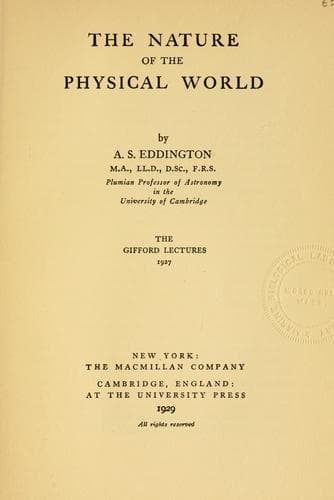
The nature of the physical worldEddington, Arthur Stanley, Sir
Philosophy
The nature of the physical world
Eddington, Arthur Stanley, Sir
Physics -- Philosophy; Science -- Philosophy
It is obviously one of the conditions of the problem that the same
elephant should be concerned in the weighing experiment and in the
tobogganing experiment. How can this identity be expressed in a
description of the world by pointer readings only? Two readings may be
equal, but it is meaningless to inquire if they are identical;
if then the elephant is a bundle of pointer readings, how can we ask
whether it is continually the identical bundle? The examiner
does not confide to us how the identity of the elephant was ensured;
we have only his personal guarantee that there was no substitution.
Perhaps the creature answered to its name on both occasions; if so the
test of identity is clearly outside the present domain of physics.
The only test lying purely in the domain of physics is that of
continuity; the elephant must be watched all the way from the scales
to the hillside. The elephant, we must remember, is a tube in the
four-dimensional world demarcated from the rest of space-time by a more
or less abrupt boundary. Using the retina of his eye as an indicator
and making frequent readings of the outline of the image, the observer
satisfied himself that he was following one continuous and isolated
world-tube from beginning to end. If his vigilance was intermittent he
took a risk of substitution, and consequently a risk of the observed
time of descent failing to agree with the time calculated.[41] Note
that we do not infer that there is any identity of the contents of
the isolated world-tube throughout its length; such identity would be
meaningless in physics. We use instead the law of conservation of mass
[Pg 257]
(either as an empirical law or deduced from the law of gravitation)
which assures us that, provided the tube is isolated, the pointer
reading on the schedule derived from the weighing-machine type of
experiment has a constant value along the tube. For the purpose
of exact science “the same object” becomes replaced by “isolated
world-tube”. The constancy of certain properties of the elephant is not
assumed as self-evident from its sameness, but is an inference from
experimental and theoretical laws relating to world-tubes which are
accepted as well established.
Public-domain text, read in full here on John Shaqi.
Reviews
Reviews
No reviews yet
Be the first to share your thoughts on this work.
Elsewhere in the archive
Join the Discussion
Join the discussion
Sign in to leave a comment or review.
Sign InorCreate an account