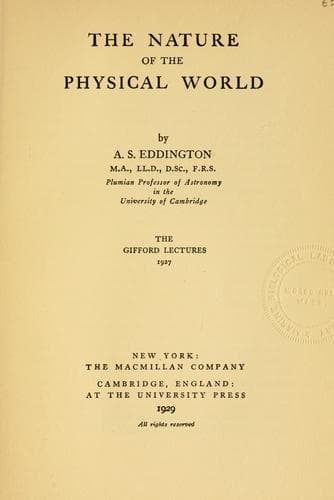
The nature of the physical worldEddington, Arthur Stanley, Sir
Philosophy
The nature of the physical world
Eddington, Arthur Stanley, Sir
Physics -- Philosophy; Science -- Philosophy
Limitations of Physical Knowledge. Whenever we state the
properties of a body in terms of physical quantities we are imparting
knowledge as to the response of various metrical indicators to its
presence, and nothing more. After all, knowledge of this kind
is fairly comprehensive. A knowledge of the response of all kinds
of objects—weighing-machines and other indicators—would determine
completely its relation to its environment, leaving only its inner
un-get-atable nature undetermined. In the relativity theory we
accept this as full knowledge, the nature of an object in so far
as it is ascertainable by scientific inquiry being the abstraction
of its relations to all surrounding objects. The progress of the
relativity theory has been largely due to the development of a powerful
mathematical calculus for dealing compendiously with an infinite scheme
of pointer readings, and the technical term tensor used so
largely in treatises on Einstein’s theory may be translated schedule
of pointer readings. It is part of the aesthetic appeal of the
mathematical theory of relativity that the mathematics is so closely
[Pg 258]
adapted to the physical conceptions. It is not so in all subjects. For
example, we may admire the triumph of patience of the mathematician
in predicting so closely the positions of the moon, but aesthetically
the lunar theory is atrocious; it is obvious that the moon and the
mathematician use different methods of finding the lunar orbit. But
by the use of tensors the mathematical physicist precisely describes
the nature of his subject-matter as a schedule of indicator readings;
and those accretions of images and conceptions which have no place in
physical science are automatically dismissed.
Public-domain text, read in full here on John Shaqi.
Reviews
Reviews
No reviews yet
Be the first to share your thoughts on this work.
Elsewhere in the archive
Join the Discussion
Join the discussion
Sign in to leave a comment or review.
Sign InorCreate an account