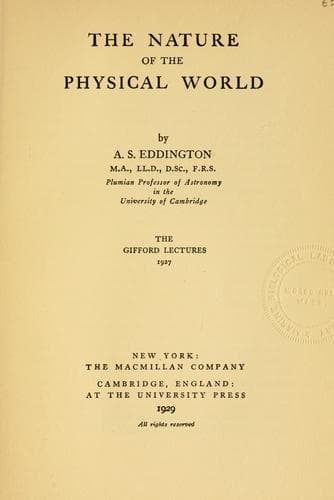
The nature of the physical worldEddington, Arthur Stanley, Sir
Philosophy
The nature of the physical world
Eddington, Arthur Stanley, Sir
Physics -- Philosophy; Science -- Philosophy
The recognition that our knowledge of the objects treated in physics
consists solely of readings of pointers and other indicators transforms
our view of the status of physical knowledge in a fundamental way.
Until recently it was taken for granted that we had knowledge of a much
more intimate kind of the entities of the external world. Let me give
an illustration which takes us to the root of the great problem of the
relations of matter and spirit. Take the living human brain endowed
with mind and thought. Thought is one of the indisputable facts of the
world. I know that I think, with a certainty which I cannot attribute
to any of my physical knowledge of the world. More hypothetically, but
on fairly plausible evidence, I am convinced that you have minds which
think. Here then is a world fact to be investigated. The physicist
brings his tools and commences systematic exploration. All that he
discovers is a collection of atoms and electrons and fields of force
arranged in space and time, apparently similar to those found in
inorganic objects. He may trace other physical characteristics, energy,
temperature, entropy. None of these is identical with thought. He might
set down thought as an illusion—some perverse interpretation of the
[Pg 259]
interplay of the physical entities that he has found. Or if he sees
the folly of calling the most undoubted element of our experience an
illusion, he will have to face the tremendous question, How can this
collection of ordinary atoms be a thinking machine? But what knowledge
have we of the nature of atoms which renders it at all incongruous
that they should constitute a thinking object? The Victorian physicist
felt that he knew just what he was talking about when he used such
terms as matter and atoms. Atoms were tiny billiard
balls, a crisp statement that was supposed to tell you all about their
nature in a way which could never be achieved for transcendental
things like consciousness, beauty or humour. But now we realise that
science has nothing to say as to the intrinsic nature of the atom.
The physical atom is, like everything else in physics, a schedule of
pointer readings. The schedule is, we agree, attached to some unknown
background. Why not then attach it to something of spiritual nature of
which a prominent characteristic is thought. It seems rather
silly to prefer to attach it to something of a so-called “concrete”
nature inconsistent with thought, and then to wonder where the thought
comes from. We have dismissed all preconception as to the background of
our pointer readings, and for the most part we can discover nothing as
to its nature. But in one case—namely, for the pointer readings of my
own brain—I have an insight which is not limited to the evidence of
the pointer readings. That insight shows that they are attached to a
background of consciousness. Although I may expect that the background
of other pointer readings in physics is of a nature continuous with
Public-domain text, read in full here on John Shaqi.
Reviews
Reviews
No reviews yet
Be the first to share your thoughts on this work.
Elsewhere in the archive
Join the Discussion
Join the discussion
Sign in to leave a comment or review.
Sign InorCreate an account