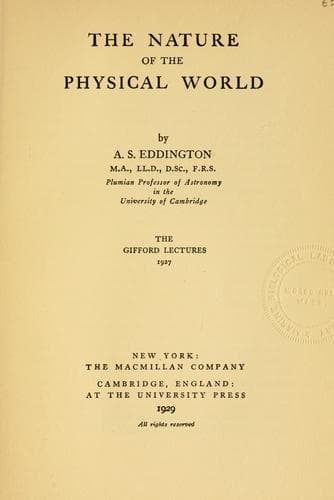
The nature of the physical worldEddington, Arthur Stanley, Sir
Philosophy
The nature of the physical world
Eddington, Arthur Stanley, Sir
Physics -- Philosophy; Science -- Philosophy
Einstein’s law in its analytical form is a statement that in empty
space certain quantities called potentials obey certain
lengthy differential equations. We make a memorandum of the word
“potential” to remind us that we must later on explain what it means.
We might conceive a world in which the potentials at every moment
and every place had quite arbitrary values. The actual world is not
so unlimited, the potentials being restricted to those values which
conform to Einstein’s equations. The next question is, What are
potentials? They can be defined as quantities derived by quite simple
mathematical calculations from certain fundamental quantities called
intervals. (MEM. Explain “interval”.) If we know the values of
the various intervals throughout the world definite rules can be given
for deriving the values of the potentials. What are intervals? They
are relations between pairs of events which can be measured with a
scale or a clock or with both. (MEM. Explain “scale” and
“clock”.) Instructions can be given for the correct use of the scale
and clock so that the interval is given by a prescribed combination
of their readings. What are scales and clocks? A scale is a graduated
strip of matter which.... (MEM. Explain “matter”.) On second
thoughts I will leave the rest of the description as “an exercise to
the reader” since it would take rather a long time to enumerate all the
properties and niceties of behaviour of the material standard which
a physicist would accept as a perfect scale or a perfect clock. We
pass on to the next question, What is matter? We have dismissed the
metaphysical conception of substance. We might perhaps here describe
the atomic and electrical structure of matter, but that leads to the
microscopic aspects of the world, whereas we are here taking the
[Pg 262]
macroscopic outlook. Confining ourselves to mechanics, which is the
subject in which the law of gravitation arises, matter may be defined
as the embodiment of three related physical quantities, mass (or
energy), momentum and stress. What are “mass”, “momentum”
and “stress”? It is one of the most far-reaching achievements of
Einstein’s theory that it has given an exact answer to this question.
They are rather formidable looking expressions containing the
potentials and their first and second derivatives with respect
to the co-ordinates. What are the potentials? Why, that is just what I
have been explaining to you!
Public-domain text, read in full here on John Shaqi.
Reviews
Reviews
No reviews yet
Be the first to share your thoughts on this work.
Elsewhere in the archive
Join the Discussion
Join the discussion
Sign in to leave a comment or review.
Sign InorCreate an account